Australian SkillSelect Points: A Practical Guide for Skilled Migrants
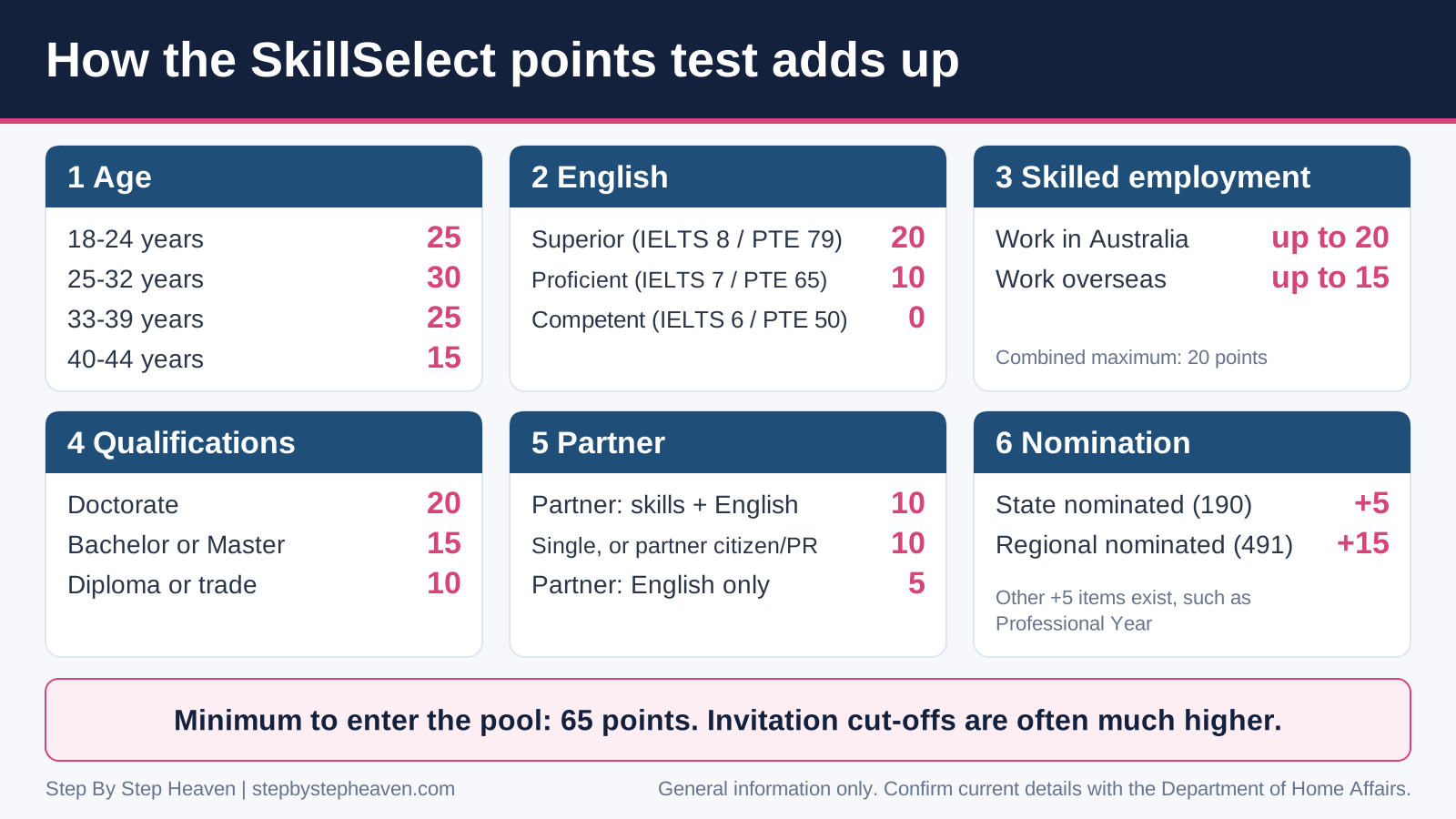
Submitting an Expression of Interest through SkillSelect is a defining milestone in a skilled migration journey. But before you get there, you have to face a hard truth: the statutory minimum of 65 points only gets you into the pool. It does not get you invited. For many occupations, recent invitations have landed well above that, so the real work is going through the points table line by line and working out where you can still move the needle.
For my husband and me, that exercise was sobering. He is the primary applicant, in construction. I am the partner. We are not young, and age is the category that hurts most as you get older. So we had to collect every point that was still available.
The Anatomy of the SkillSelect Points System
Australia’s points test evaluates candidates across several categories:
- Age: maximum 30 points (optimal bracket: 25 to 32 years)
- English language proficiency: up to 20 points (Superior English)
- Overseas and Australian skilled employment: up to 15 to 20 points combined
- Educational qualifications: up to 20 points (Doctorate) or 15 points (Bachelor or Master’s)
- Australian study and regional credentials: 5 points each for qualifying study
- Partner skills: up to 10 points based on your partner’s qualifications or status
- Nomination or sponsorship: 5 points (Subclass 190) or 15 points (Subclass 491)
What Age Really Costs
Age is the one category you cannot work on. The bands step down as you get older: 30 points for ages 25 to 32, 25 for ages 33 to 39, and 15 for ages 40 to 44. That is a difference of up to 15 points between the best band and the last band before the cut-off. If you are already in a lower band, the only honest response is to look everywhere else.
That is exactly what we did. We stopped treating our score as a fixed number and started listing which categories were still movable: English, partner points, nomination, and (in principle) additional credentials.
1. The Fastest Point Accelerator: Targeting Superior English (+20 Points)
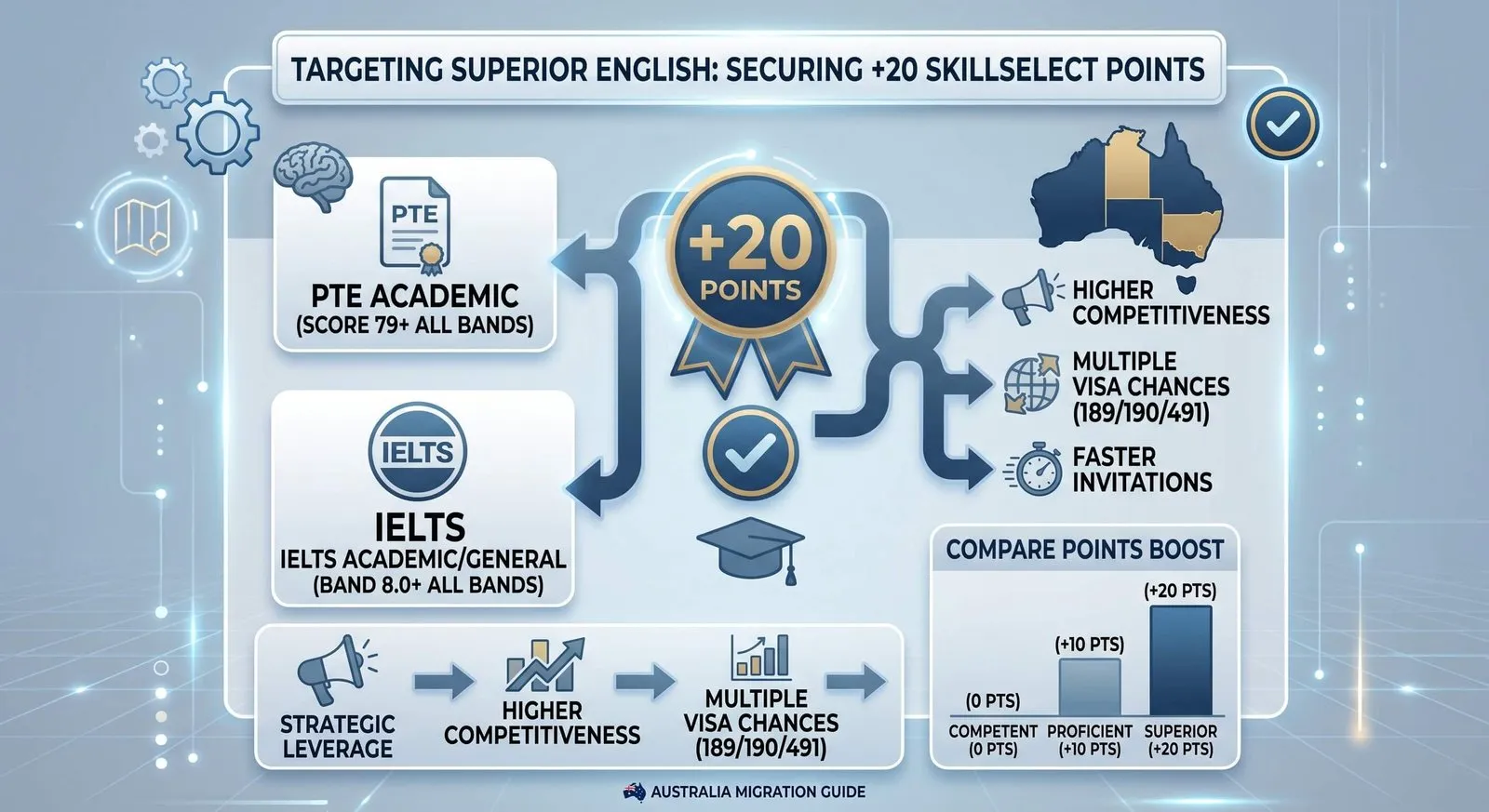
If the main applicant can reach Proficient or Superior English, this is often the biggest single lever available. Moving from Competent English (0 points) to Proficient (10) or Superior (20) does not require years of extra work experience the way employment points do.
The Department of Home Affairs recognises PTE Academic, IELTS and Cambridge English, among others. Superior English requires a minimum of 79 in each of the four PTE skills, or 8.0 in each IELTS band. It takes serious preparation, and I recommend a timed practice test before you book anything.
2. Partner Skills (+5 to +10 Points): Where I Came In
This is the category I ended up contributing to directly. Your marital status and your partner’s background matter more than most people realise:
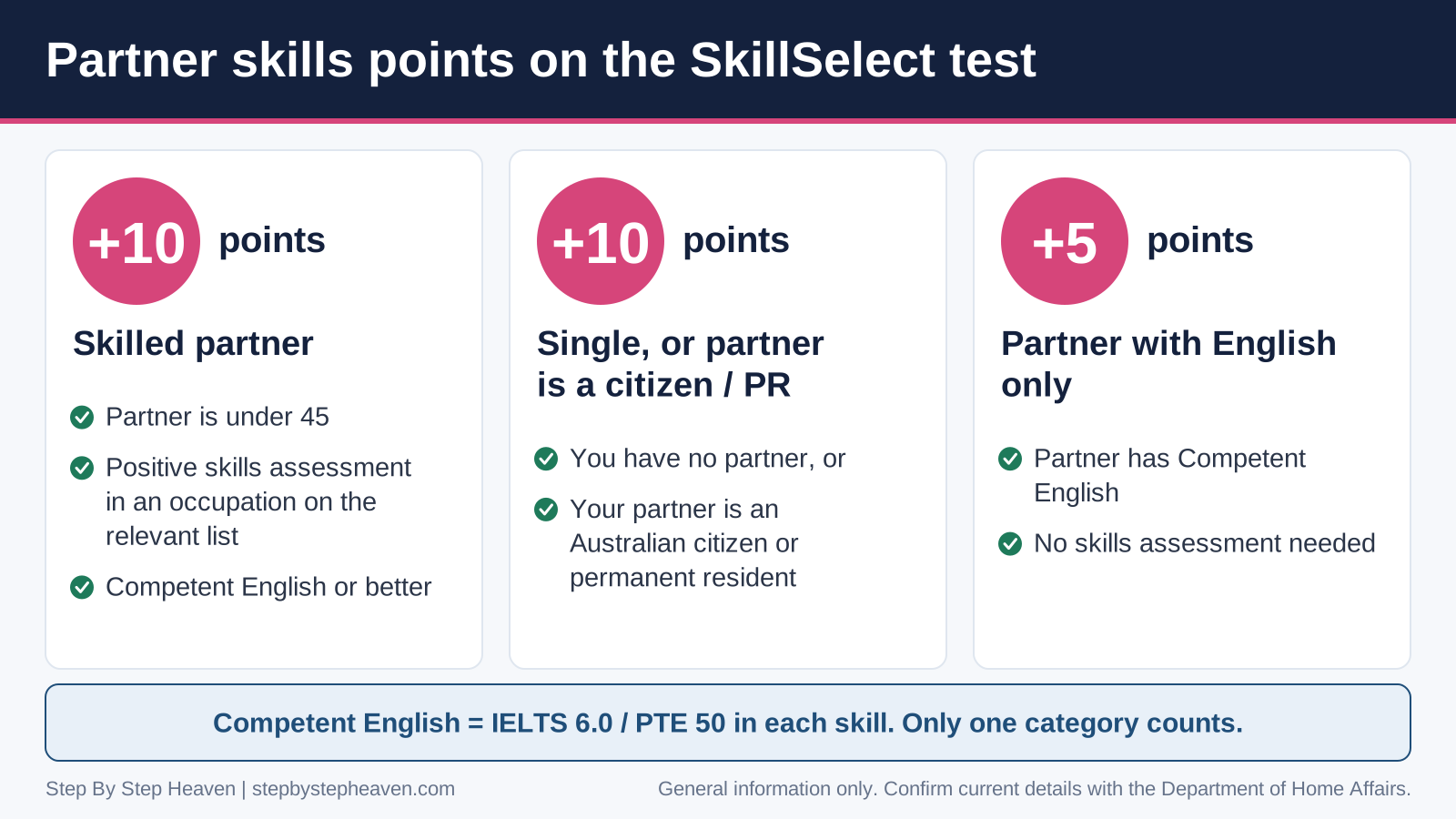
- Single applicants receive an automatic 10 points
- Partner with Competent English and a positive skills assessment (under 45, occupation on the same skilled list) adds 10 points
- Partner with Competent English only (PTE 50+ or IELTS 6.0 in all bands) adds 5 points
- Australian citizen or PR partner adds 10 points
For us, the realistic path was the +5. I did not need a high score. I needed Competent English in every skill so that we could claim 5 points for a partner with English. Those 5 points were worth a great deal to us, because every point mattered. It took me three English tests (one IELTS and two PTE) between late November and 10 March, while I was working and raising a four-and-a-half-year-old. The two PTE sittings cost a little over CAD 300 each, and I passed the second one, on 10 March, with a score of about 65. I share what went right and wrong in my English score post.
If your partner has not sat an English test yet, this is genuinely one of the most cost-effective ways to add points, but do not underestimate the effort. Speaking may come easily and writing may not, or the other way around.
3. Professional Year and Credentialled Community Language (+5 Points Each)
There are also smaller options: the NAATI credentialled community language test, which grants 5 points for demonstrated interpreting ability in a recognised language, and the Professional Year program, a 44-week bridging program for graduates in accounting, engineering or IT that also grants 5 points. These did not fit our situation, but if either applies to your background, every 5 points counts more than it sounds like it should.
4. State and Regional Nomination (+5 to +15 Points)
This one made the real difference. If your baseline independent score plateaus below where invitations are landing, moving toward a nominated stream is often the most direct route:
| Stream | Points Awarded | Key Condition |
|---|---|---|
| Subclass 190 (Nominated) | +5 Points | Commitment to live and work in the nominating state for 2 years |
| Subclass 491 (Regional) | +15 Points | Commitment to reside and work within designated regional areas for 3 years |
The 15 points from the 491 took us from a modest score to something realistic for invitation. I explain how we approached the state decision in how to choose a state.
How We Ran Our Numbers
If you are trying the same exercise, this is the order I would use:
- Write down your current score category by category, using only what you can document.
- Mark what is fixed (age, past employment, existing qualifications).
- List what is movable (English, partner points, nomination, extra credentials).
- Attach a cost and time to each option. For us, that included test fees, study time and the cost of retakes.
- Check recent invitation trends for your occupation, to know how many points is enough.
My Summary Checklist Before Updating an EOI
- Confirm your skills assessment is still valid (typically three years from issue)
- Confirm your English test results are within the validity window
- Re-check that your claimed work experience dates align with what your assessing body accepted
- Review current state migration lists, since priority occupations and regional criteria shift throughout the year
- Update the EOI whenever a score changes, so your ranking reflects your real points
The Takeaway
Optimising a SkillSelect score is not about gaming the system. It is about being honest with yourself about which categories are still movable, then putting real effort into those specifically. For us, English (mine, as the partner) and regional nomination did almost all the work. Your own mix will depend on where you are starting from.
This reflects my own experience working through the points test and is not immigration advice. Points values, test requirements and nomination conditions change over time, so always confirm current figures directly through SkillSelect and the Department of Home Affairs.