How I Rebuilt Ten Years of Addresses and Trips for Form 80
Form 80 took me several hours, and almost all of that time went on one thing: working out where I had lived and where I had travelled over the last ten years. I had not kept a trip list, I had changed passports along the way, and some of the dates were buried in old paperwork. This post is about how I rebuilt all of it, in the order I did it, and what I would do first if I started again.
I am not a migration agent, and this is only our own experience. Check the form itself for your own case.
In short: no single record covered ten years. I got there by using every source I had, one after another, by starting from records I had already organised for another application, and by not writing a date until I had checked it.
What Form 80 Asks For
Home Affairs asks for two character forms with a skilled visa application: Form 80, “Personal particulars for assessment including character assessment”, and Form 1221, “Additional personal particulars information”. Form 80 is the heavy one. It asks for your addresses and your travel outside the country over the last ten years. Read the current PDF for the exact wording, because forms get updated.
The same ten-year history also decides which police certificates you need. Home Affairs asks for an overseas police certificate from every country where you spent a total of 12 months or more in the last 10 years since you turned 16, as described on its character requirements page. The word “total” matters: several shorter stays in the same country can add up. So the work on your addresses is not only for Form 80. It tells you which certificates to chase. I wrote about how that went for us in the Japanese police certificate post and the RCMP post.
Why Mine Was Harder Than I Expected
Three things made my ten years messy:
- Four countries between us. My husband and I have lived in four countries, so the address history was not a simple list.
- A lot of trips. Before our son was born we travelled one to three times a year, to visit family overseas and for holidays, including Mexico.
- Two passports. I changed my passport once during those years, so my stamps were split across two books instead of one.
I had never written any of it down in one place. In the application itself, the residence history was already the slowest section, as I described in our lodging story. Form 80 asked for the same kind of memory again, with trips added on top.
Where I Looked
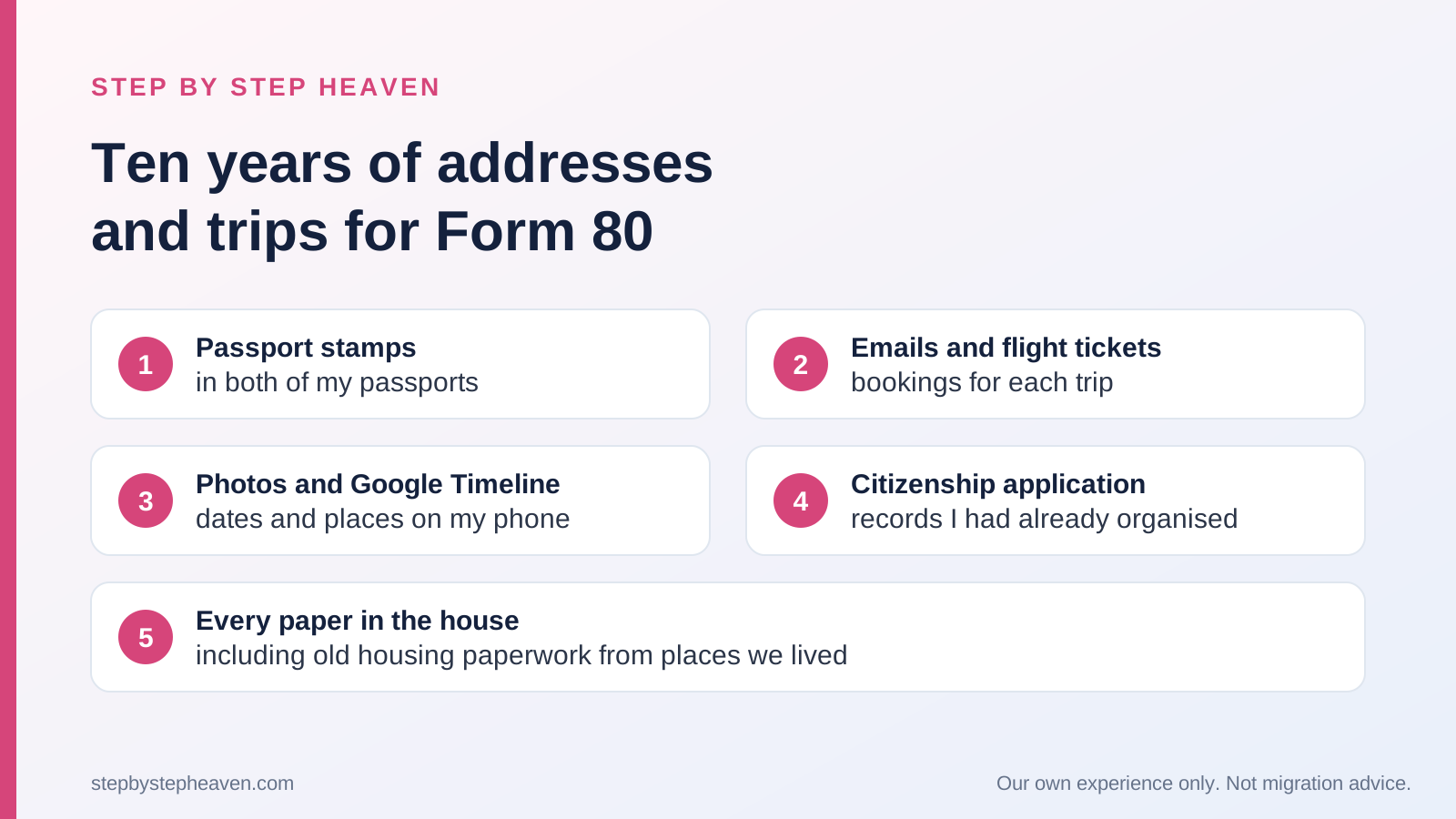
I started with the sources that are easiest to open and moved towards the ones that take real digging. I used all of them, because no single source covered everything. Here is what each one was good for, and where it is weak.
| Source | What it was useful for | Where it falls short |
|---|---|---|
| Passport stamps, in both passports | Dates I could point to for entering and leaving a country | Not every trip leaves a clear stamp, and mine were split between two books |
| Emails | Booking confirmations and messages around each trip | Only as good as your search words and how old the account is |
| Flight tickets | Dates and destinations for each journey | Shows when you planned to travel, so I still wanted a second source |
| Photos | A dated picture is a quick way to confirm a trip or a place | Only proves you were there on that day, not the whole stay |
| Google Timeline | A record of where my phone had been, for cross-checking | Only helps for the years it was switched on |
| Every paper in the house | Dates for when we lived in each place | Slow, and you do not know what you will find until you look |
The “falls short” column is my own reasoning about each source, not a rule from Home Affairs. The point is that each source has a gap, which is why I did not trust any one of them on its own. When one source gave me a date, I checked it against another before I wrote it down.
The Shortcut: Records I Had Already Organised
The most useful thing I had was not a document from the trips themselves. Earlier I had applied for Canadian citizenship, and that application had asked me to gather records of the same kind, about where I had been and where I had lived. I had organised them properly at the time. When I came to Form 80, I started from those records instead of from nothing, and then filled the gaps from the other sources. I wrote about how the citizenship and visa timelines overlapped.
If you have recently done another application that asked for your history, such as a citizenship, another visa, or a police check, look there first. You may already have done most of the hard thinking.
The Hardest Part: Addresses
The trips were tedious, but the addresses were the real search. I went through every document in our home, including old housing paperwork from places I used to live, to find the dates I moved in and out. It is the kind of paper nobody keeps in a folder, so it took digging.
I also went through every timeline I had before I was willing to write a date down. It was slow, but I would rather have a date I could check than a date I guessed.
The Order I Would Work In
This is what I would do now, based on how my own search went. It is a method I am suggesting, not something Home Affairs requires.
- Start with a master list of addresses. Oldest to newest, with a move-in and move-out date for each. Everything else hangs off this list.
- Add the trips year by year. One year at a time is much less overwhelming than trying to recall ten years at once.
- Fill in what you already know, then use the passport stamps to anchor the dates.
- Look for the gaps. Wherever the stamps and the addresses do not line up, check the emails, tickets and photos.
- Check every date against a second source before it goes on the form.
- Copy from the master list, not from memory. The application and Form 80 both ask about where you have lived, and I would want them to agree.
How Checking a Second Source Works
Here is the pattern, using made-up dates so you can see the logic. These are not from our application.
Say a flight booking email says you left on 3 July and came back on 17 July. Your photos from that trip run from 4 July to 16 July, and your passport has an entry stamp dated 4 July. The three sources agree closely, so the dates are safe to use. Now say a different trip has a booking email but no photos and no stamp. That one I would leave marked as “needs another source” and come back to it, rather than writing it in as if it were certain.
This is slower than filling in the form from memory, but it is the reason I did not feel I was guessing on anything.
My Husband’s Form
My husband did his own Form 80 separately, from his own records. I did not try to combine our histories, and I would not. Our trips overlap, but each person has their own passport stamps, emails and paperwork to check, and one person’s date should not stand in for the other’s.
Keep the Forms Consistent
Home Affairs says on its “Applying for a skilled visa” page (last updated 30 September 2026) that an application with all the information and documents the department needs gets a faster outcome, so you should check it twice before submitting. For the history questions, that is why I like the master list: the addresses on Form 80, the residence section of the application and the police certificate decisions all come from one source, so they agree with each other.
A Note on Privacy
These records contain passport details, addresses and flight bookings. On this blog I leave out names, numbers and addresses. If you are sharing documents with an agent, send them the way your agent asks, and do not post them anywhere public.
What I Do Not Know
I cannot tell you how Home Affairs treats a date that is a few days off, or what to do when no record exists at all. I have not tested either, so I will not guess. If you are stuck on a date you cannot prove, ask a registered migration agent before you invent one. Questions I would take to an agent:
- What should I write if I only know the month of a trip?
- Do short trips need to be listed in the same way as longer ones?
- If I changed passports, is there anything extra to say about the old one?
A Simple Log You Can Start Today
If I were starting again, I would keep these two lists from the moment I decided to apply. Even before that, they are worth having.
Trips outside the country
| Left | Returned | Country | Reason | Where the proof is |
|---|---|---|---|---|
| Family / holiday / work | Passport, email, photo |
Addresses
| From | To | Full address | Where the proof is |
|---|---|---|---|
| Lease, bill, paperwork |
Fill them in with the oldest dates first, while the records are still easy to find. Then add each new trip as it happens, so you are never rebuilding it later.
What I Would Do If I Started Again
- Keep the trip and address lists from day one, not when the form arrives.
- Look first at any earlier application that already asked for the same history.
- If you changed passports, find both before you start.
- Do each person’s form from that person’s own records.
- Do not write a date you have not checked against a second source.
- Set aside a block of time. Mine took several hours.
Where to Go Next
I describe the whole stage in how we lodged our application, and the other slips in the mistakes we made or nearly made. If you are not sure where you are in the process, start with the Start Here guide.
I am a Japanese-born applicant living in Canada, applying with my husband for the Australian subclass 491 visa. I am not a registered migration agent, and this is my own experience, not legal advice.