Our 70 Points, Category by Category: How a 491 Score Really Added Up
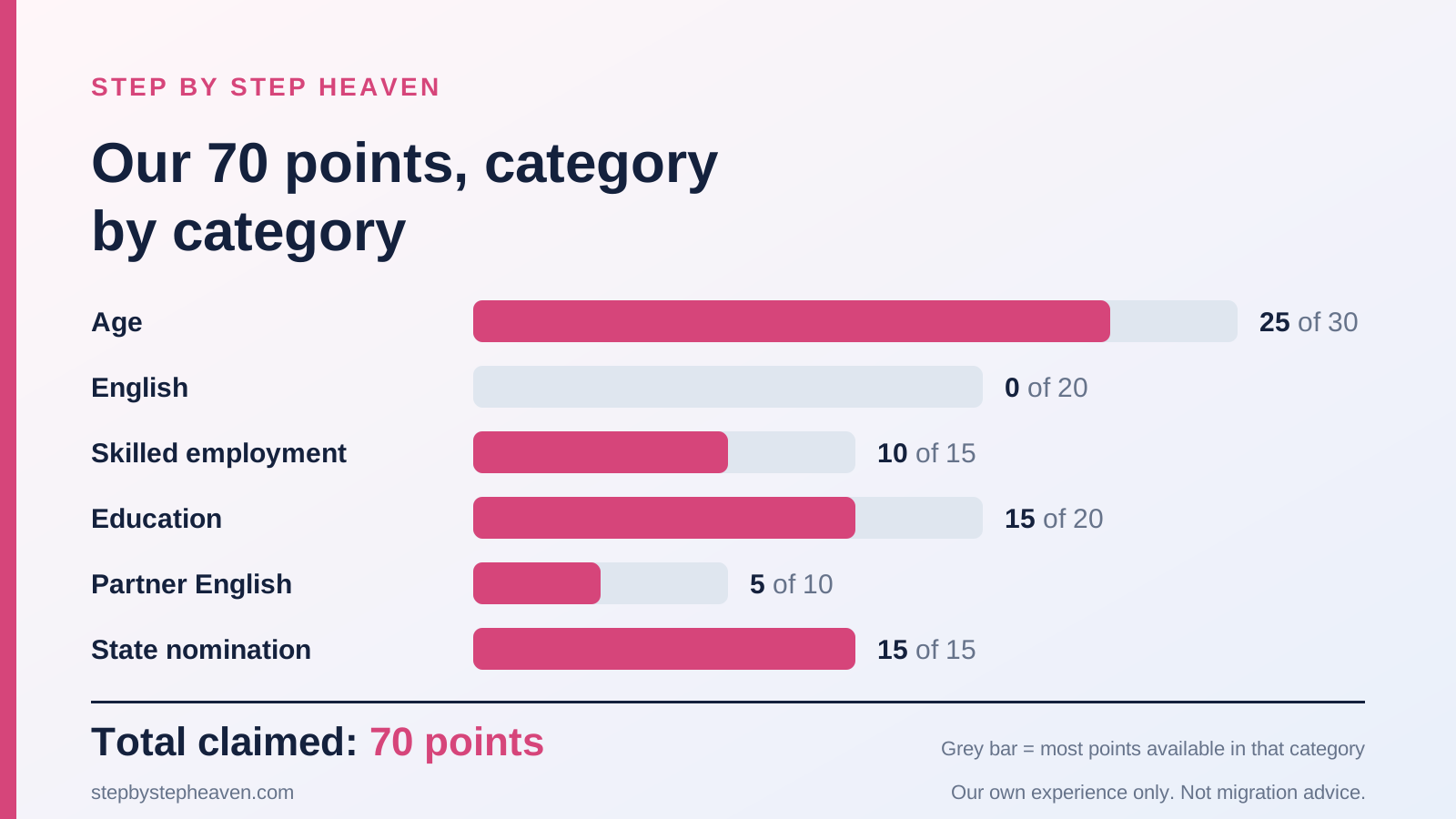
Most points guides explain the table in the abstract. This post shows the numbers from one real family. When my husband and I submitted our Expression of Interest (EOI) for the subclass 491 visa, our total was 70 points. Below is where each point came from, what we lost in every category, and what that taught us about which levers were actually movable.
I am not a migration agent, and this is only our own experience. Points values change, so check the official table for your own case. I checked the Home Affairs points table for the subclass 491 on 20 October 2026.
In short: without the 15-point state nomination we had 55 points, which is below the minimum of 65. The 491 nomination was the only thing that took us over the line.
Our 70 Points, Line by Line
My husband is the primary applicant, in construction, and I am the partner. Here is what we claimed.
| Category | What we claimed | Points | Most available |
|---|---|---|---|
| Age | The 33 to 39 band | 25 | 30 |
| English | IELTS: writing 6.0, other bands 7.0 (counts as Competent English) | 0 | 20 |
| Skilled employment | About 7 years of work outside Australia | 10 | 15 |
| Education | A Bachelor degree or higher completed in Canada | 15 | 20 |
| Partner skills | My Competent English | 5 | 10 |
| State nomination | Subclass 491 | 15 | 15 |
| Total | 70 |
The “most available” column is the largest award in that category on the official table. We claimed nothing in the other categories, such as Australian study, a Professional Year or a credentialled community language.
How Each Line Works
Age (25 points). The official table gives 30 points for at least 25 but less than 33, 25 points for at least 33 but less than 40, and 15 points for at least 40 but less than 45. We were in the 25-point band, so age had already cost us 5 points compared with the best band. Age is the one category nobody can improve, and it only gets worse with time.
English (0 points). Competent English earns 0, Proficient English earns 10 and Superior English earns 20. My husband’s best IELTS result was 7.0 in listening, reading and speaking, and 6.0 in writing, which made 7.0 overall. For Proficient English, Home Affairs requires at least 7 in each of the four IELTS components (Proficient English page, checked 20 October 2026). So writing, one full band short, kept all of his English at Competent level, and we claimed 0 points. A 7.0 overall is not enough on its own, because each of the four components has to reach 7. I will come back to this one, because it is where we spent the most effort.
Skilled employment (10 points). For work outside Australia, the table gives 0 points for less than 3 years, 5 for 3 to under 5 years, 10 for 5 to under 8 years and 15 for 8 years or more. My husband’s 7 years put him in the 10-point band. Home Affairs says the employment must be in the nominated occupation or a closely related one, that “employed” means at least 20 hours a week, and that you can only count the 10 years before the invitation. It also says you must provide documents to support every claim in your EOI. Proving those 7 years was the hardest part of the whole assessment, which I describe in his TRA skills assessment post.
Education (15 points). At least a Bachelor degree of a recognised standard earns 15 points. A Doctorate earns 20. My husband completed a Bachelor degree or higher in Canada, and that is what we claimed.
Partner skills (5 points). If your partner is also an applicant on the same visa and has Competent English, you get 5 points. If the partner also meets the age and skills assessment requirements, it is 10. I only needed the 5, which is why I took English tests. I tell that story in IELTS vs PTE.
State nomination (15 points). For the 491, a nomination from a state or territory adds 15 points. For a 190 it would have been 5.
Why 55 Points Was Not Enough
Take away the nomination and our score was 55. Home Affairs says on its Expression of Interest page that you need to meet or exceed the points threshold of 65 to be invited to apply (checked 20 October 2026). That gave us three possible visa routes, and the sums were simple:
| Route | Our score | Reaches 65? |
|---|---|---|
| 189 (no nomination) | 55 | No |
| 190 (nomination adds 5) | 60 | No |
| 491 (nomination adds 15) | 70 | Yes |
That is the real reason the 189 was never realistic for us. It was not a feeling. Age had already taken points away, and English at Competent level gave us nothing. The 491’s 15 points were the only thing that pushed us above the threshold. I explain how that fed into our state decision in the Queensland nomination story, and how the three visas compare in 189 vs 190 vs 491.
The Categories We Did Not Claim
The official table has several smaller categories that we did not use. I list them here with their values because they are easy to overlook, and because for some people they are the quickest way to add points.
| Category | Points | What it needs, in short |
|---|---|---|
| Australian study requirement | 5 | A degree, diploma or trade qualification from an Australian institution that meets the study requirement |
| Study in regional Australia | 5 | The same, obtained while living and studying in a designated regional area, not by distance |
| Professional Year in Australia | 5 | A completed Professional Year in accounting, ICT or engineering, within the last four years |
| Credentialled community language | 5 | A recognised credential in a community language |
| Specialist education qualification | 10 | A research masters or doctorate from an Australian institution in a listed science, technology, engineering or ICT field |
None of these applied to us, so our 70 came entirely from the six lines above. Employment points also have a ceiling: Home Affairs says the most that can be awarded for employment experience is 20, even if the separate overseas and Australian bands add up to more.
What If We Had Pulled Each Lever?
These are sums from the official table, not things that happened to us. They show how much each category could have moved our score.
| If this had changed | Points added | New total |
|---|---|---|
| English: writing from 6.0 to 7.0 (other bands already 7.0) | +10 | 80 |
| English from Competent to Superior | +20 | 90 |
| Work experience from 7 years to 8 years | +5 | 75 |
| Partner with a skills assessment instead of English only | +5 | 75 |
Seen like this, English was clearly the biggest swing available to us, and that matches what I felt at the time. A single extra year of work experience would have added 5 points, but that is something only time can give. The partner line needs its own suitable skills assessment in an occupation on the same list as the primary applicant’s, and the partner must be under 45 with Competent English at the time of invitation, so it was not a quick fix either.
The Lever We Did Not Pull: Better English
If I had to pick the single most movable category, it was English. It was also the most frustrating, because we were so close. My husband’s IELTS bands were 7.0 in every skill except writing, which came back at 6.0. That one skill, one band short, was the difference between 0 and 10 points, which would have taken us from 70 to 80.
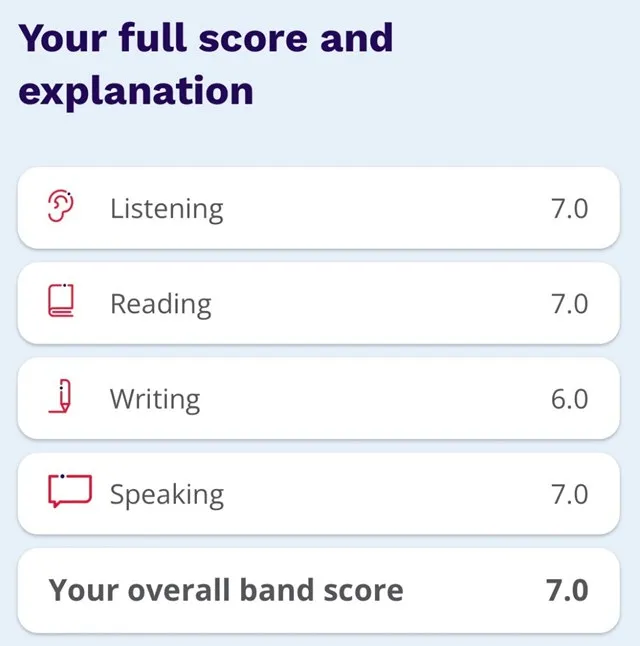
My husband’s best IELTS result: 7.0 in listening, reading and speaking, 6.0 in writing, 7.0 overall. It was his first sitting, and it is the one we used.
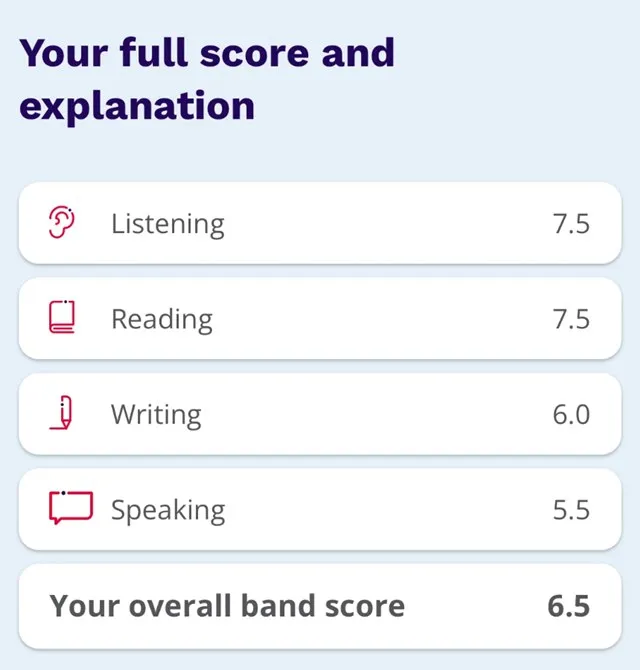
A later sitting: 7.5 in listening and reading, 6.0 in writing and 5.5 in speaking, 6.5 overall. The writing score did not improve.
It was also the hardest category to work on. We were both working, we had a young son, and studying happened at night. We sat tests more than once, and every attempt cost money. In the end we decided to put in the EOI with his best result, which was his first one, rather than pay for yet more attempts. His later sitting did not improve the writing score.
I will be honest that this was a judgment call, not a clear right answer. Home Affairs says an EOI can be updated at any time before you receive an invitation, so a better score could in principle be added later. We chose not to wait and spend more.
One thing worth knowing if you are in a similar position: the Proficient English page says Home Affairs accepts IELTS results that include a One Skill Retake for eligible visas, and tells you to check the relevant visa page to see if you are eligible. I have not checked whether that applies to the 491, so please look it up before you rely on it.
If you are deciding the same thing, here is the question I would ask: how many more attempts am I willing to pay for, and what do I do if the extra points still do not come? Decide that before you book the next test.
When the Cut-off Moved
While we were preparing, the points system changed once, around February, and the cut-off went up. I do not remember the details or the exact numbers, so I will not quote any. What I do remember is how it felt: for a while I wanted to give up. A target that moves while you are studying at night is demoralising.
The practical lesson is the same as before. Do not treat your score as a fixed number or assume today’s pass mark will be tomorrow’s. Keep the categories you can still change in view, and check the official pages before you rely on anything, including this post.
How Fast It Moved for Us
The EOI went in on 16 March. Queensland’s pre-approval email arrived on 20 March, four days later, and the nomination was approved around 10 April. We lodged the visa application on 11 May. As I understand it, construction is short of workers in Australia right now, which may be why a 70-point EOI moved quickly. I cannot prove that, and I would not rely on it.
Please do not read our 70 as a target for you. Home Affairs states that meeting the threshold does not guarantee an invitation. A score that worked for a construction trade in our situation may not work for another occupation. Check recent invitation results and your state’s lists for your own.
Work Out Your Own Score
Here is the exercise I would do first, with the official table open beside you:
- Write down every category, even the ones you expect to score zero in.
- Next to each, write only what you can document.
- Add the nomination points for the visa you are considering, and see which routes reach 65.
- Mark which categories are fixed (age, past experience) and which can move (English, partner points).
- Put a time and cost beside each movable option, and decide in advance when to stop.
| Category | Your claim | Points | Can it still change? |
|---|---|---|---|
| Age | No | ||
| English | |||
| Skilled employment | |||
| Education | |||
| Partner skills | |||
| Nomination |
What I Would Do Differently
- Price the English retakes before booking the first one, and decide how many attempts to pay for.
- Start gathering the evidence for the employment claim on day one, because every point has to be documented.
- Run the 55-versus-65 sum early, so the pathway decision is made on numbers rather than hope.
For a wider look at the points categories, I wrote a practical guide to SkillSelect points, and the whole sequence is in the Start Here guide.
I am a Japanese-born applicant living in Canada, applying with my husband for the Australian subclass 491 visa. I am not a registered migration agent, and this is my own experience, not legal advice.