Bringing Our Senior Dog to Australia: 18 Steps and the Costs
Our dog, Cha Cha, is coming to Australia with us. She is a senior Bichon Frise, and she is family, so leaving her behind was never really an option, even once we saw the paperwork and the price tag. This post is what we have actually learned and started doing to bring her from Canada to Australia, by way of a few months in South Korea with family.
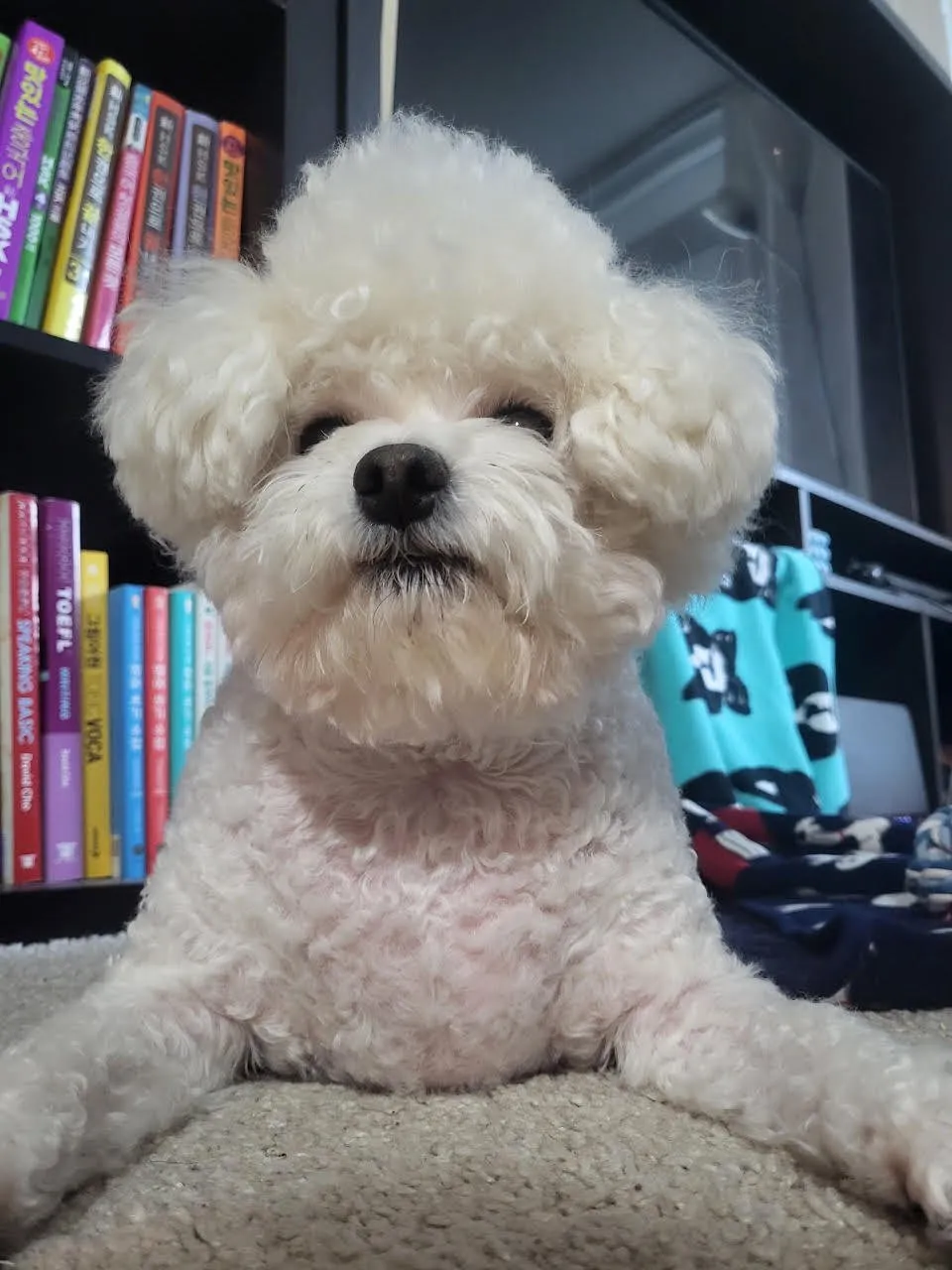
Cha Cha, our senior Bichon Frise, who is coming to Australia with us.
I am not a vet or a pet relocation agent. Import rules change, and every family’s route is different, so treat this as a real example, not a script to copy exactly. If anything here matters to your own move, confirm it directly with the Australian Department of Agriculture, Fisheries and Forestry (DAFF) and a vet experienced in pet export paperwork.
Why the Route Is Not a Straight Line
A dog can usually travel directly from Canada to Australia. Ours is not going to, because we are spending a few months in South Korea with family before we continue on to Australia ourselves. So Cha Cha’s paperwork has to work for two destinations: an exit from Canada, a stay in Korea, and then an entry into Australia from there. If your move is a direct one, your path will be simpler than ours.
Cha Cha next to an open suitcase.
The One Thing That Changes Everything: Order of Operations
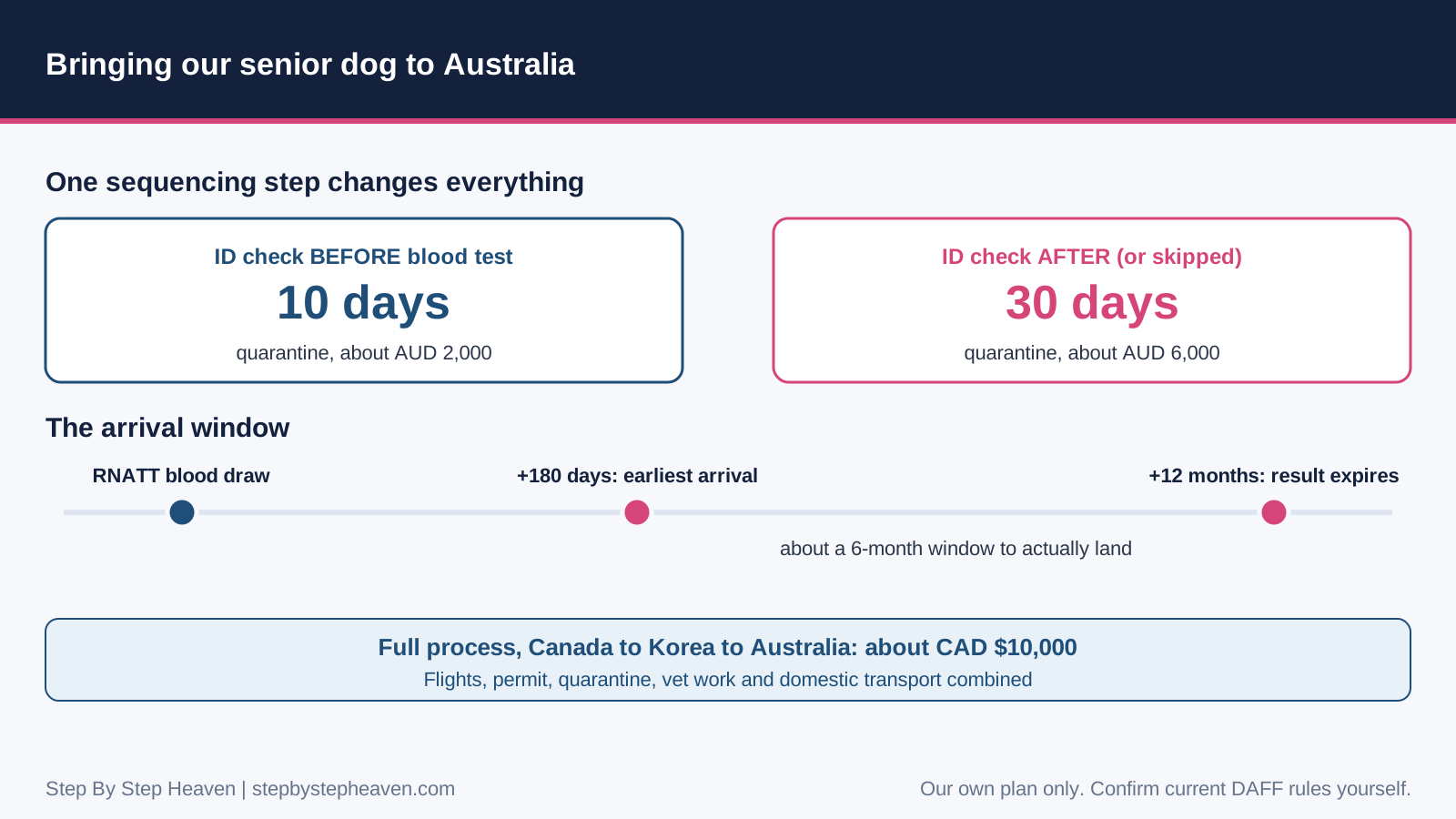
Before the step-by-step, this is the single most important thing I have learned, and it is easy to miss. Australia requires a government-approved vet to scan your dog’s microchip and confirm identity, and that identity check has to happen before the blood sample is taken for the rabies antibody test (RNATT), not after.
Get that order right, and your dog is eligible for the minimum 10-day quarantine on arrival. Get it wrong, or skip it, and the default becomes 30 days. In our case, quarantine runs at roughly AUD 200 a day, so that is the difference between about AUD 2,000 and AUD 6,000, for exactly the same dog, just because of which appointment happened first. I checked this against outside sources while writing this post, and it holds up: this sequencing requirement is real and has no exceptions.
If you take away nothing else from this post, take that.
The Steps, in Order
This is our actual plan, based on where Cha Cha is in her life and health, with real timing and rough costs. Every dog’s required tests can differ based on age, breed and health history, so use this as a shape, not a checklist to copy line for line.
Before any of the official steps, we also had Cha Cha fully checked over by our own vet, including bloodwork, simply because she is a senior dog and we wanted to know her baseline before putting her through everything else. That was our own precaution, not part of Australia’s required sequence, so I have left it out of the numbering below. The official process, for us, actually starts here:
1. Rabies booster. Her last rabies vaccination had likely lapsed, so she needed a fresh one before anything else official could proceed. She had it on 6 October 2026, in the afternoon, on the same day as the identification check below.
2. Microchip identification through CFIA, by a government-approved vet. This has to come before the blood draw for the antibody test, for the 10-day quarantine to apply, not after. This step was completed on 6 October 2026, as I describe below.
3. The RNATT blood test. (Planned for November.) This measures rabies antibodies and has to be drawn within a window of 12 months to 180 days before departure. The sample goes to an approved overseas laboratory, and the 180-day countdown starts from the day the sample arrives there, not the day it is drawn. Usefully, the same result can also be used for entry into South Korea, within its own 24-month validity window, so we are not duplicating this test for each country.
4. Apply for an Australian Import Permit, through Australia’s BICON system, as soon as the RNATT result is in. Processing is quoted at 20 to 40 business days, but can run as long as 123 business days, so this needs to go in with real buffer. The fee runs roughly AUD 480 to 600.
5. A separate export health certificate for Korea, reusing the same RNATT result rather than drawing blood again, specifically naming South Korea as the destination.
6. Travel from Canada to Korea. Moving between two countries that are both approved for the process does not reset or pause the 180-day countdown.
7. Finish the 180-day wait, partly in Canada and partly in Korea.
8. Canine influenza (CIV) vaccination in Korea. Two doses, two weeks apart, and the final dose has to be at least 14 days before departure from Korea to Australia. This step is specific to whichever country you are actually departing from last, which for us is Korea, not Canada.
9. Inside the final 45 days before departure: confirm or refresh core vaccines, and test for three specific diseases. In our case, two of the three tests were waived: one because Cha Cha is desexed, and one because she is up to date on the relevant vaccine. Rules like this depend on your own dog’s history, so do not assume the same exemptions apply to yours.
10. Parasite treatments on a strict schedule: an internal treatment inside 45 days of departure, external parasite treatment starting 30 days out and maintained through departure, and a second internal treatment within 5 days of leaving.
11. A final pre-export exam and an Australia-specific Veterinary Health Certificate, done by a vet who has actually handled this paperwork before. We learned that a general vet clinic without export experience may not even recognise what this document is, so this is worth confirming directly rather than assuming any vet can issue it.
12. A separate export quarantine certificate from Korea’s own animal quarantine authority, independent of the health certificate, with both originals travelling with Cha Cha.
13. Book the flight to Melbourne as cargo. Dogs travel in the cargo hold under a manifest booking, not in the cabin, so this is booked through an airline or an agent rather than a normal ticket.
14. Book and prepay the quarantine facility at Mickleham, near Melbourne, as soon as the import permit is approved. Spots are first-come, first-served, so this is not something to delay.
15. Departure day. Cha Cha flies alone as cargo. We do not need to be there in person; a DAFF officer receives her at the airport in Melbourne and takes her straight to the quarantine facility.
16. Quarantine at Mickleham, 10 days in our case, because the identification step was done correctly before the blood test. Visits are not allowed during this period.
17. Domestic transport from Melbourne to the Gold Coast, booked through a local pet transport service once quarantine ends. We do not need to travel to Melbourne ourselves for this, although we could if we wanted to collect her in person.
18. Arrival on the Gold Coast, and reunion with the family.
Where We Are Now (21 October 2026)
Here is exactly how far we have got, with dates.
- Microchip. Cha Cha’s microchip was put in in May 2022, so the identity check was about confirming a chip that has been in place for years.
- 6 October 2026: identification check, done. A CFIA veterinary inspector scanned her microchip and signed and stamped the official Identification Declaration for dogs and cats exported from Canada to Australia. The form records the date of the microchip scan as 6 October 2026 and describes her as a small white Bichon Frise.
- 6 October 2026, the same afternoon: rabies vaccination, done. We took her to the vet for the booster after the identity check, so the order was identity check first, vaccination second.
- RNATT blood test: planned for early or late November. It has to wait about a month after the vaccination. DAFF says the RNATT is done at least 3 to 4 weeks after a primary vaccination course, and that the identity check and the blood test cannot happen at the same visit (DAFF’s rabies page, last updated 26 February 2025, checked 21 October 2026). It also says that if your pet is already vaccinated, you should talk to your vet about the timing.
- Import permit: not applied for yet. At the time of the identity check, the permit application number on the form was “N/A”.
- Korea: around April 2027. That is when we plan to be there.
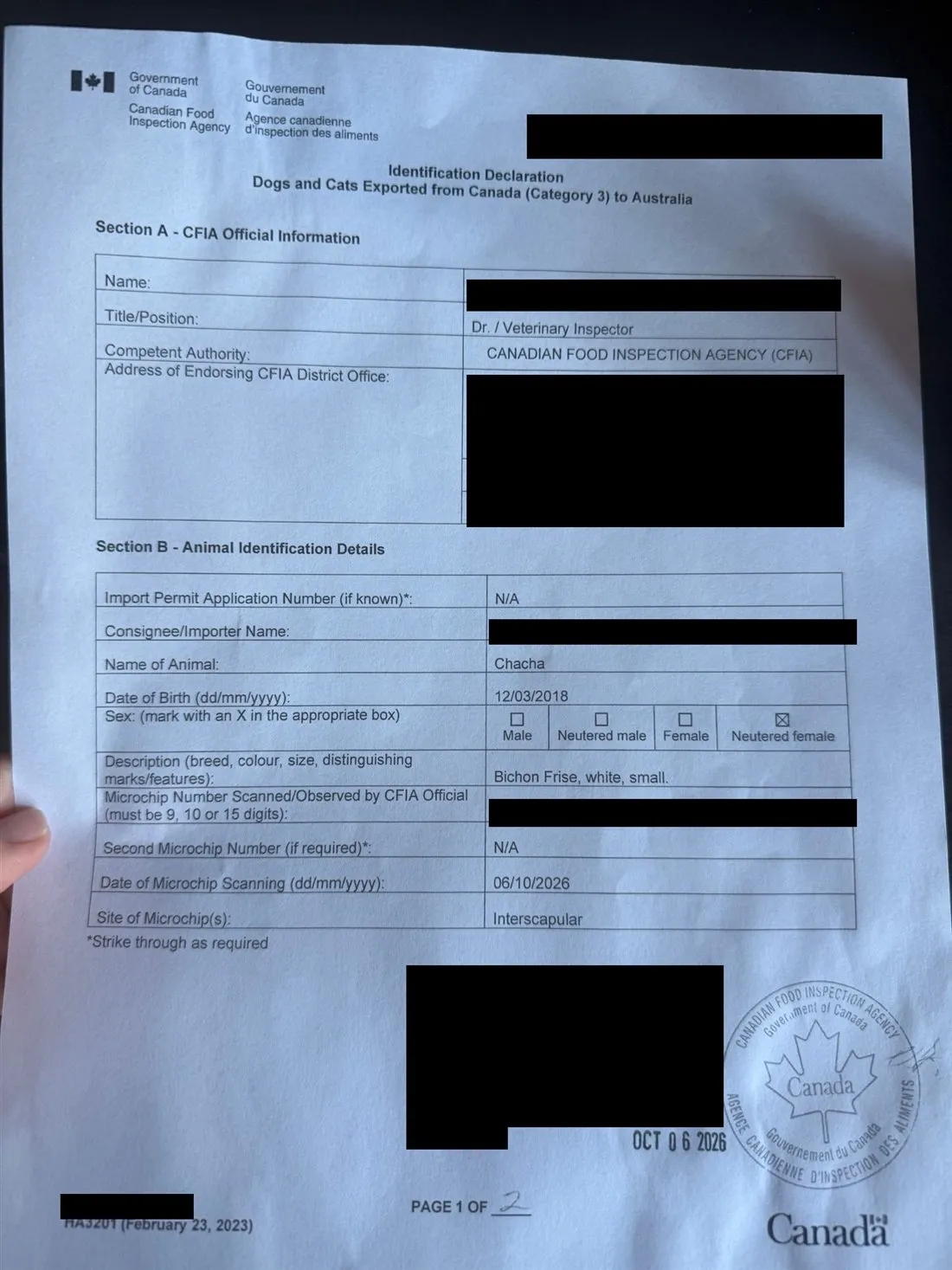
Cha Cha’s Identification Declaration from the Canadian Food Inspection Agency. I have covered the reference number, names, address, microchip number and signature.
DAFF says the identity check is an optional but recommended step that reduces the minimum quarantine for dogs and cats from Group 3 countries from 30 days to 10 days, and that only an official government veterinarian can complete it. I have not shared the microchip number or any of the official’s details.
The Window We Actually Have to Land In
Because of how the 180-day wait and the 12-month RNATT validity interact, we have a specific window to actually arrive in Australia, not just a single date. Roughly: the earliest we could land is 180 days after the blood sample reaches the lab, and the latest is 12 months after that same blood draw, when the test result expires. In our case that works out to a window of about six months. If the blood is drawn in November 2026 and the sample reaches the lab soon after, my own sum is that the earliest Cha Cha could fly is around May 2027, and the result would expire in November 2027. That sum is mine, so please check it against DAFF’s rules for your own dates.
If we miss that window entirely, the whole process does not just need a small fix. Identification, vaccinations, the RNATT test and the 180-day wait all restart from zero. Knowing this window gives us real flexibility, so if something on the Korea side, like selling a property, runs long, we are not necessarily in trouble as long as we still land inside it.
What It Actually Costs
Looking at everything together, flights, the import permit, quarantine fees, veterinary work on both sides of the ocean, and the domestic transport once she lands, we are budgeting around CAD 10,000 in total. That is not a small amount, and we thought hard about it. In the end, she is family, and we were not willing to leave her behind over cost.
Cha Cha resting on a bench in the sun.
We also compared quotes from three different Korea-based relocation services that each handle the Korea-to-Australia leg. Their prices for the same overall service were not wildly different from each other, but they did differ in what was bundled in, how responsive they were, and how well they seemed to actually understand the Australian paperwork rather than just the Korean side. That difference in how well a provider understood the Australia-specific requirements mattered more to us than the small differences in price.
What Worries Me Most
Cha Cha is a senior dog now, and the thing I think about most is the stress of the actual travel: a long flight, alone, in cargo, at her age. The cost is real too, but it was the travel itself that gave me pause before anything else.
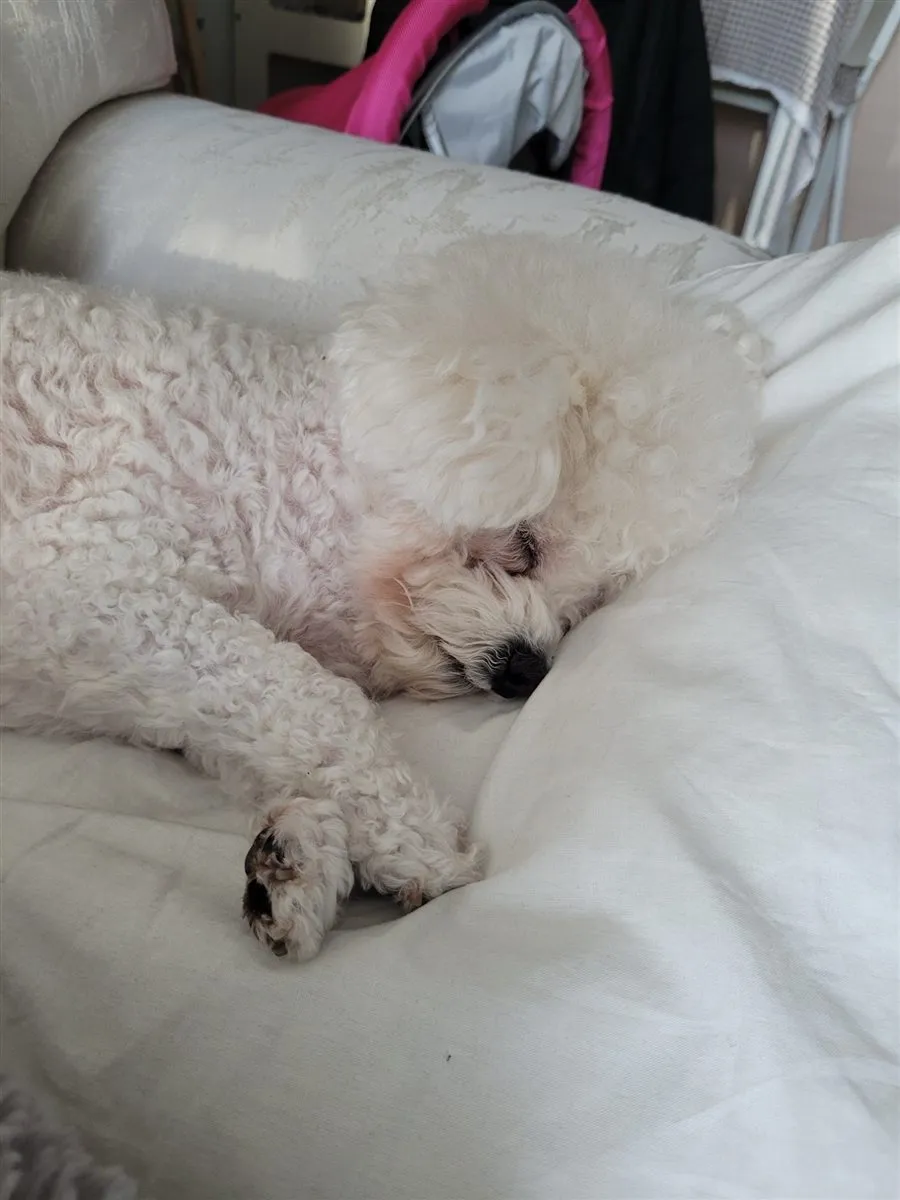
Cha Cha asleep at home. She is a senior dog now.
What Surprised Me
I expected to feel worse about the quarantine stay than I do. I found videos online showing the inside of the Mickleham facility, and the conditions looked much better than I had imagined. Seeing the actual space, rather than just reading the word “quarantine,” made a real difference to how I feel about this part of the process.
Checks I Would Make Before Booking Anything
- Confirm whether your pet’s identification check must happen before any blood test, and schedule it that way
- Build your timeline backward from the RNATT 180-day wait and 12-month expiry, not forward from today
- Ask which of your dog’s required vaccines or tests might be waived based on their own history, rather than assuming the full list applies
- Find a vet with real experience in Australian export paperwork, not just a general clinic
- Book cargo flights and quarantine as separate, specific bookings, not as part of a normal travel itinerary
- Get multiple quotes from relocation services and compare how well each understands Australia’s specific rules, not just the price
- Calculate your full arrival window, not just a single target date, so you have some flexibility
Where to Go Next
This sits alongside everything else we are preparing for the move. Read about what we have researched about life in Queensland, and see where we currently stand in our visa waiting update.
This reflects our own research and planning as of 1 October 2026, with the identification step updated on 21 October 2026 and is not veterinary or import advice. Pet import rules change and depend on your own animal’s history, so confirm current requirements directly with the Australian Department of Agriculture, Fisheries and Forestry and a vet experienced in pet export.