Subclass 189 vs 190 vs 491: Which Australian Skilled Visa Is Right for You?
When we first mapped out our skilled migration options, the same three subclasses kept coming up: 189, 190 and 491. On paper they all run through SkillSelect and score you on the same core criteria: age, English, qualifications and work experience. What took us longer to understand was how differently they play out once you get past the points calculator, and why our own situation ended up making the decision for us.
A quick note on who “we” are. My husband works in construction (drywall and plastering, about six to seven years in Canada) and is the primary applicant. I am the partner. We started in December, we were not young, and age costs points, so we had to be realistic about every choice below. In the end, a 189 was simply not realistic for us because of our age.
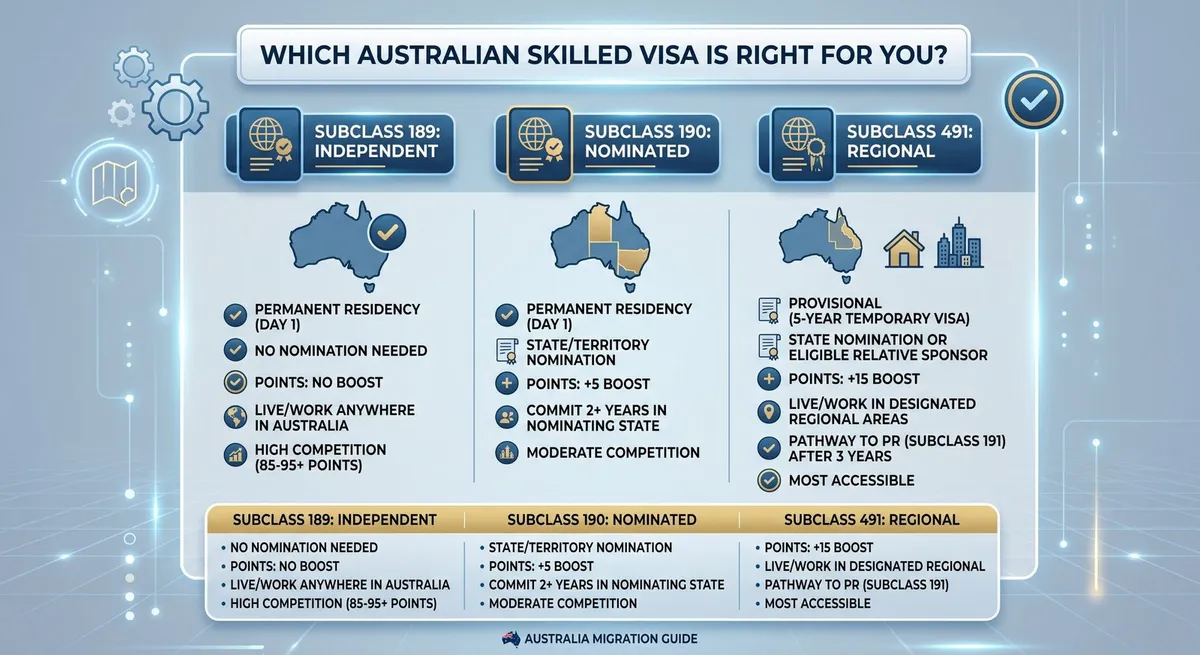
The Quick Comparison
| Feature | Subclass 189 (Independent) | Subclass 190 (Nominated) | Subclass 491 (Regional) |
|---|---|---|---|
| Residency Status | Permanent Residency (Day 1) | Permanent Residency (Day 1) | Provisional (5-year temporary visa) |
| Nomination / Sponsor | None required | State or Territory government | State government or eligible relative |
| Points Boost | 0 points | +5 points | +15 points |
| Location Freedom | Anywhere in Australia | Nominating state (2-year commitment) | Designated regional areas only |
| PR Transition | Immediate | Immediate | Subclass 191 PR after 3 years |
If you only remember one row, make it the points boost. It is the difference between the pathways that most affects who gets invited.
189: Ultimate Freedom, but the Cutoffs Are Brutal
Subclass 189 is the one almost everybody wants first. There is no nomination, no location commitment, and permanent residency from day one. But there is no bonus either, and recent invitation rounds for many occupations have landed in the 85 to 95+ point range, far above the 65-point minimum needed just to lodge an EOI.
We did the math on our own profile. With age already taking points away, the 189 was not realistic for us without a much stronger score in other categories. If your occupation is in very high demand and your points are already strong, 189 is worth chasing. It keeps every door open. If you are not close to recent cutoffs, holding out for it can mean a long wait for an invitation that may never come.
190: The Middle Ground
The 190 adds 5 points and gives immediate permanent residency, in exchange for a commitment to live and work in the nominating state, generally for two years. Two things decide whether it works for you: whether a state lists your occupation for the 190, and whether 5 extra points is enough to reach competitive territory.
It can be a very good option for people in the mid-70s to mid-80s range, and I would tell anyone in that band to check the state lists before ruling it out. Just be realistic about how far 5 points goes when the gap to recent cutoffs is large.
491: Where the Numbers Worked
The 15-point boost from the 491 is the biggest swing available in the nomination category. For a couple with limited points, it can be the difference between “not competitive” and “realistically invitable.” That is why we focused here.
It comes with real trade-offs:
- A provisional visa. The 491 lasts five years, and you apply for permanent residency (Subclass 191) after at least three years of meeting the requirements, including living and working in a designated regional area.
- Location. You must live, work and study in a designated regional area. Regional does not mean remote. It includes real cities, and the list has included places such as Adelaide, Perth, Newcastle and the Gold Coast. Melbourne, Sydney and Brisbane are outside it. The list changes, so check the current one.
- A separate nomination step. A state or territory has to nominate you first. Each has its own rules, and I cover that in how to choose a state.
- Conditions after grant. Visa condition 8579 applies to the holder and family members. I wrote about it in the points test reform post.
What Partners Can Add
This is the piece people overlook. A partner can add points, so it is worth checking before you decide any pathway is out of reach. If the partner has Competent English (PTE 50 or IELTS 6.0 in each part), that adds 5 points. If the partner also has a positive skills assessment in a suitable occupation and is under 45, it can add 10. In our case, that was my job. I took three English tests (one IELTS and two PTE) to give us those 5 points, and I tell that story in my English score post. It was a lot of effort, but with age already costing us points, every point counted.
How to Compare the Three for Yourself
Do not compare them as concepts. Compare them against your own numbers:
- Calculate your points honestly using the official points table, without rounding up.
- Look at recent invitation trends for your occupation on each pathway, for SkillSelect and for the states.
- Add each pathway’s bonus (0, 5 or 15) and see where you land.
- Check the trade-offs you are willing to accept: location, provisional status, waiting.
- Do the timing math. Invitation rounds can move quickly for some occupations, and your English test, skills assessment and overseas police certificates all take time.
How We Decided
We did not pick the 491 because it is easy in the abstract. We picked it because it was the pathway where our profile could actually compete, and because we were prepared to live in a regional area to get there. Speed mattered too. Invitation rounds for my husband’s occupation were running when we started, so we had a reason to move quickly, and I will explain how in my timeline.
The Takeaway
Your ideal choice depends on your baseline points and whether you are willing to commit to a regional location for a few years. If your score is already strong, 189 keeps every option open. If you are a little short, 190 or 491 can bridge the gap, but only if you are honest about the commitment each one carries. Official details for each subclass are on the Department of Home Affairs site: Subclass 189, Subclass 190 and Subclass 491.
This reflects my own comparison process and is not immigration advice. Points cutoffs, nomination criteria and processing times change over time, so always confirm current figures directly on the Department of Home Affairs website.