My 491 Visa Timeline: From Late-November Research to Waiting After Lodging
When we started our 491 visa journey, the one thing I could not find anywhere was a real timeline. Government pages tell you the steps. Forums tell you horror stories. Nobody shows you what an ordinary experience looks like from the inside: which dates things actually happened on, how long each phase took, and what we would change if we started over.
So here is our actual timeline, with real dates. Every applicant’s occupation, points and countries of residence are different, so yours will not match ours. Treat this as a realistic reference point, not a guarantee.
Our Starting Point
Before the dates make sense, here is where we stood:
- A trade in demand. My husband is the primary applicant. He has worked in construction in Canada for about six to seven years, in drywall and plastering, which as far as I know is a shortage occupation in Australia. Invitation rounds for his occupation were running when we began, so we felt we had to move fast.
- Age working against us. We are not young, and age had already cost us points. A 189 was not realistic for us, so we went for the regional 491.
- A partner English requirement. I am the partner, and I needed Competent English so that we could claim 5 partner points.
- A migration agent. We worked with one, though we still gathered all of our own documents.
- Applying from outside Australia. We live in Canada. I am originally from Japan, so I needed police certificates from both Canada and Japan.
- Real life running alongside. I was working during the day and raising our four-and-a-half-year-old son. I also had a personal deadline on 13 March, and I wanted to get as much of the preparation done as I could before it. And on top of everything, I was going through Canadian citizenship at the same time (more on that below).
The Timeline
| Date | What happened |
|---|---|
| Late November 2025 | Started researching, and took my first English test (IELTS) |
| 5 December 2025 | My IELTS result came out |
| Late December to mid-January | Christmas and the Australian holiday shutdown. Much of Australia effectively closes until mid-January, so we waited |
| 28 January | Lodged my husband’s skills assessment application |
| 5 February | Trades Recognition Australia (TRA) approved it, only eight days later |
| 10 February | Applied for my Japanese police certificate |
| 27 February | My first PTE Academic sitting |
| 10 March | My second PTE sitting, which I passed with about 65 |
| 13 March | A personal deadline I wanted the heaviest preparation finished before |
| 16 March | Submitted the 491 EOI, selecting Queensland, Western Australia and Victoria |
| 20 March | Queensland approved us to move forward |
| 25 March | I passed my Canadian citizenship test |
| 30 March | Submitted our Queensland nomination application |
| 3 April | Applied for my RCMP (Canadian) police certificate |
| 10 April | The nomination came through (I do not remember whether the visa invitation arrived the same day) |
| 17 April | RCMP certificate arrived by post, about two weeks after applying |
| 20 April | Collected my Japanese police certificate in person at the Japanese consulate |
| 21 April | Filled in everything on the visa portal |
| 21 April to 11 May | Uploaded the documents that were still missing, and kept contacting my husband’s employer to update his skills and employment certificates and other evidence |
| 5 May | My Canadian citizenship oath ceremony |
| 11 May | Visa application completed and lodged |
| 12 May | Health examinations for me and our son |
| 21 May | Health examination for my husband |
| 25 July | Ministerial Direction 119 (processing priorities) announced |
| 19 September | Ministerial Directions 121 and 122 replaced it |
From lodging the skills assessment on 28 January to lodging the visa application on 11 May was about three and a half months. That is quick compared with what many people describe, and I put it down to a few things: rounds were running for my husband’s occupation, TRA moved fast, we worked at it constantly, and I was determined to get through the heavy preparation before 13 March. Notice how tightly things stack up: I passed my last English test on 10 March, three days before that deadline, and we submitted our EOI three days after it.
What Took Longest, and What Didn’t
The biggest single lesson from this timeline is that the slow items are not always the ones you expect. Our skills assessment, which many people dread, took only eight days. The Japanese police certificate took about ten weeks (10 February to 20 April), and nothing on our side could shorten it. The Canadian RCMP certificate, by contrast, took only about two weeks by post. If you have lived in more than one country, the certificates alone can set your schedule.
Once the state moved, the pace picked up. The nomination came through around 10 April, and I had everything filled in on the visa portal by 21 April. The three weeks after that were a scramble of their own: I uploaded the documents that were still missing and kept contacting my husband’s employer to update his skills and employment certificates and other evidence, until we could lodge on 11 May. Health examinations followed the day after lodging for me and our son, and ten days later for my husband. That is a useful reminder that health checks are booked once your application is underway, not before.
The English Tests: The Hardest Part for Me
This deserves its own section, because it took a lot out of me. As the partner, I did not need a high score. I did need Competent English in every skill so we could claim 5 partner points. I took three tests:
- IELTS, late November (result on 5 December). I went in lightly, mostly to see how it worked. I did not know the format or any of the small tricks.
- PTE Academic, 27 February. I prepared properly. Speaking went well, but writing was much harder than I expected.
- PTE Academic, 10 March. This is the one I passed, with a score of about 65.
The two PTE sittings cost a little over CAD 300 each, and both felt very expensive. I studied late into the night with the PTE Exam Practice app from APEUni, memorised a lot, and repeated things out loud until they felt natural. My husband was studying hard for his own English score at the same time, so it was a very tired household. The full story, with tips, is in my English score post.
The Crunch: Work, Paperwork, Sleep, Repeat
The hardest stretch was late March and April. My days looked like this: finish work, prepare documents, sleep, go back to work, prepare more documents, stay up late. Around the nomination application on 30 March there was hardly any slack, and I was already running on very little energy. I do not recommend running a migration application this way, but sometimes the timing decides for you. If you can spread it out, do.
Citizenship on the Side
I also became a Canadian citizen during this period: I passed my citizenship test on 25 March and took the oath on 5 May, six days before we lodged. My husband and our son were not part of that application; it was only mine. We might end up coming back to Canada after Australia, and I decided it would be much easier to secure Canadian citizenship before we left than after. That is a personal decision and it will not apply to everyone, but it is a good reminder to think through your longer-term options before you move.
After Lodging: Waiting, and Ministerial Direction 119
Since the citizenship ceremony and the health checks, there has been nothing to do but wait. That is its own kind of hard, after months of constant activity.
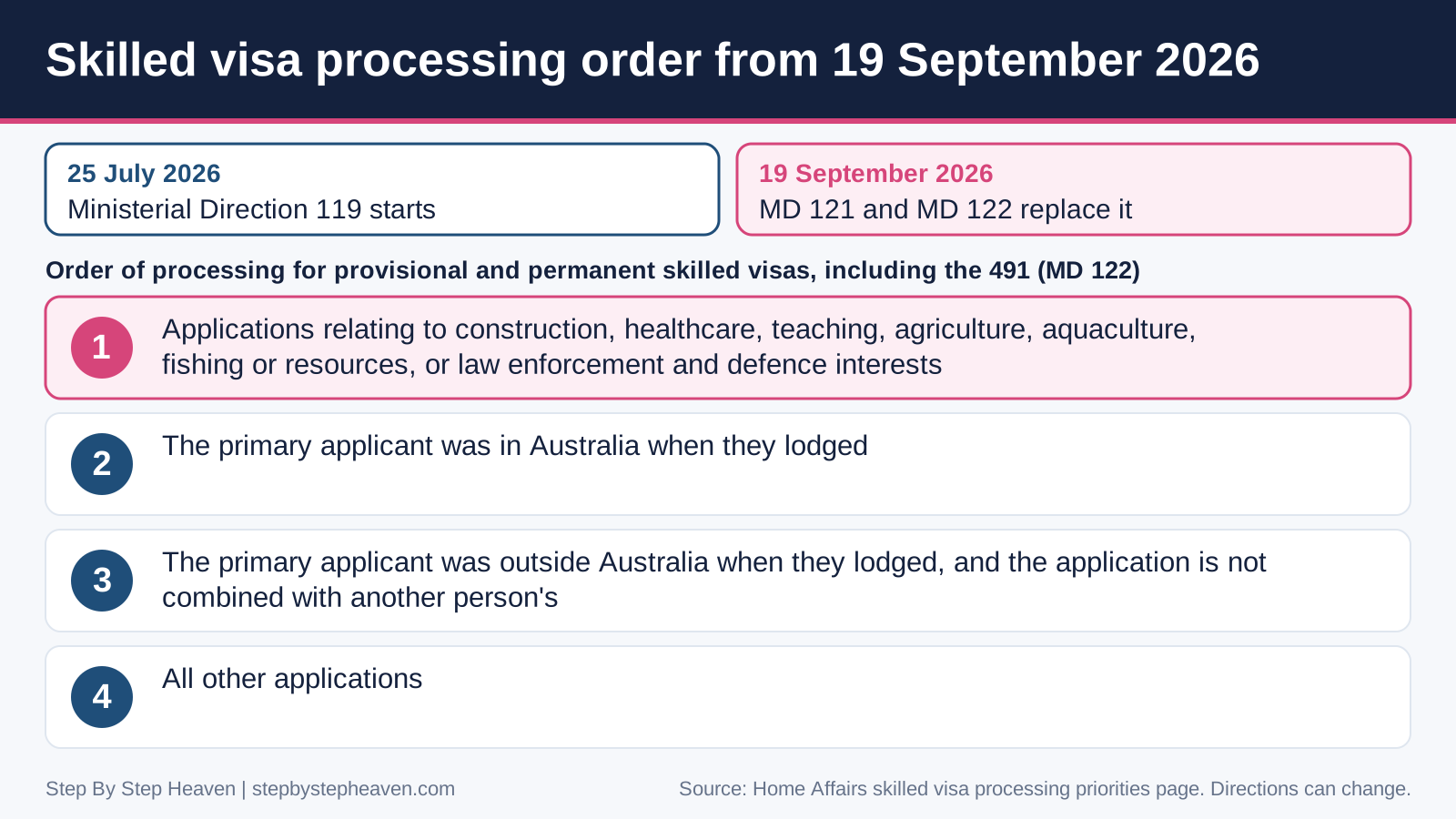
While we waited, the rules about processing order changed. We had been told the 491 was in the top priority group, and that a fast case could take roughly three to six months. Then on 25 July 2026, Ministerial Direction 119 (MD 119) was announced, and applicants who lodged from outside Australia appeared to be pushed down to the fifth and last priority group, which suggested a much longer wait for us. Onshore applicants, by comparison, seemed to be moving up. Then on 19 September 2026, Ministerial Directions 121 and 122 came into effect and replaced all processing priorities under MD 119, according to the Department’s own page. I wrote about what that means in a separate post on skilled visa processing priorities.
Honestly, a longer wait is not a disaster for us. We have a home here in Canada, and we needed time to prepare for the move anyway. But I know that is not true for everyone, and the short version is this: what happens to your application after lodgement can change even when you have done nothing wrong, so keep checking the official page.
The Checklist I Wish We’d Had at Each Stage
Before Submitting the EOI
- Confirm your occupation is on the correct list for your intended states
- Get your skills assessment fully finalised, not just started (ours took eight days, but that varies a lot by occupation and authority)
- Calculate your points total twice, using the official points table
- Check English test validity, since most require results within a set window
- Start any overseas police certificates now, especially from slow countries
While Waiting for the Response
- Check state nomination criteria, since they change
- Keep your EOI updated if anything changes (job, English score, marital status)
- Avoid letting your skills assessment or English test expire
- Keep collecting the documents that take longest
After Receiving State Approval
- Read the state’s checklist line by line. Most problems come from a single missing document, not from ineligibility
- Keep a single folder with every document, named consistently
- Ask your agent or the Department when to book health examinations, rather than guessing
During the Full Visa Application
- Use the Department’s own document checklist as your master list
- Upload documents in the exact format requested, since file size and type errors cause real delays
- Complete Form 80 carefully, because inconsistencies with your EOI cause extra processing time
- Respond to any request for information within the deadline
After Lodging
- Keep your contact details and ImmiAccount current, and check your email regularly
- Read the Department’s processing priorities page from time to time
- Do not put life on hold. Keep working and saving
What I’d Do Differently
Looking back, three things stand out:
- Start with the overseas police certificate. It was the one thing we could not speed up. Apply to the slowest country first, on day one.
- Do not use a paid test just to “see what it’s like.” I did that with my first English test. At over CAD 300 per PTE sitting, I would take a full timed practice test first, and I would drill my weakest section (writing) from the beginning.
- Plan around the holidays. If you start in late November or December, expect Australia to slow down until mid-January, and build that pause into your expectations.
I would also tell myself to sleep more. Studying until dawn works, until it does not.
Final Thoughts
If you are in the middle of your own 491 journey, the most useful thing I can tell you is that it feels chaotic because the information is scattered across government pages, forums and agent blogs that do not always agree. Having a real timeline, even someone else’s, makes the process easier to plan, because you can see roughly what is coming.
I am writing about each stage in more detail elsewhere on this blog, from why we decided to move and choosing a pathway to choosing a state and the documents we gathered. I will keep updating this post as things move forward. If you are going through this too, you are not alone.
This reflects my own experience and is not immigration advice. Timelines vary widely by occupation, points, state and country of residence, and rules change, so confirm current details with the Department of Home Affairs or a registered migration agent.