Australia Skilled Migration Points Test Reform, 491 Regional Residency, and My English Score Strategy
While we were preparing our EOI, the same headlines kept appearing: the Department of Home Affairs signalling changes to the points test, and regional visas moving from “backup plan” to a central strategy for a lot of applicants. I read up on what those changes mean in practice, because they directly affected how we approached the 491 regional pathway and, in my case, the English test.
Why Regional Pathways Stopped Being a Backup Plan
For a long time, most applicants I read about aimed for the independent 189 or the nominated 190 and treated the regional 491 as a fallback. That has shifted. With invitation cutoffs for many occupations sitting in the 85 to 95 point range, and nomination allocations tight in several states, a purely independent strategy was not realistic for us. My husband and I are not young, and age had already taken points off the table before we started.
The 491’s 15-point regional boost went from “an option” to “the option that actually worked” once we ran the numbers honestly.
What the Points Test Reform Is Trying to Change
The traditional points model rewards accumulating points across age, qualifications, employment, language and partner credentials. Reaching the 65-point minimum only gets you into the pool. In practice, this open-ended model has pushed invitation thresholds for popular occupations well above that minimum, without necessarily steering people toward where labour shortages actually are.
The direction of reform, as far as I can tell, is toward weighting the test more heavily by demonstrated economic contribution, such as high-demand trades, regional settlement and earning capacity, rather than pure point-stacking. I read this as a warning not to treat your points as a fixed number. The categories that are fixed, like age, only get worse with time. The ones you can still move, like English and nomination, deserve your effort early. Details are still changing, so check the Department’s own pages before relying on anything I say here.
What Visa Condition 8579 Requires
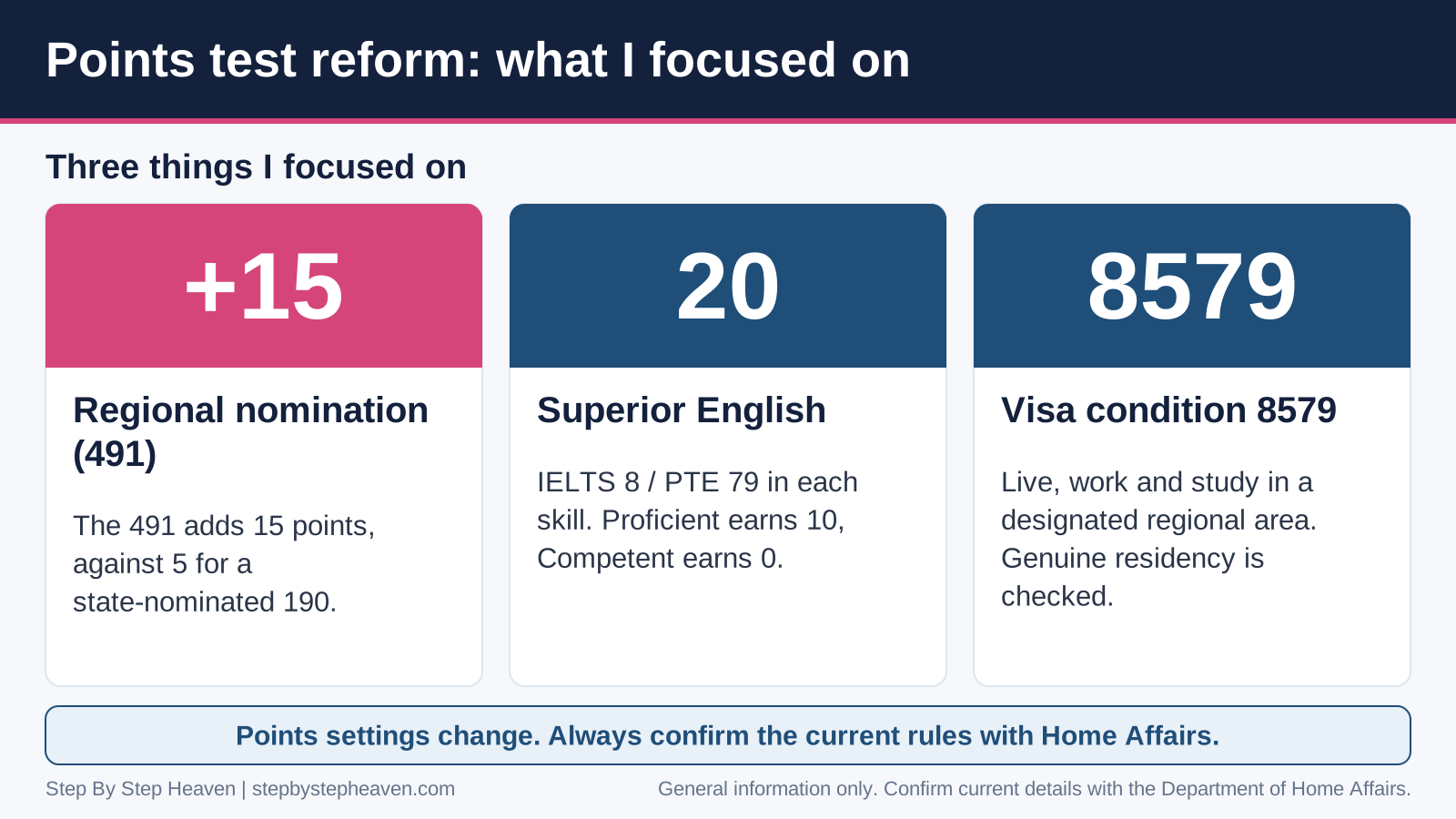
The 491 gives a five-year provisional stay in designated regional areas, with a path to permanent residency via Subclass 191 after three years. “Regional” is broader than it sounds. It includes real cities, not just small towns, which was a relief when I first looked into it.
The part I paid closest attention to is visa condition 8579. It requires the primary holder and family members on the visa to live, work and study in a designated regional area. It is not enough to hold an address there on paper. That applies to a spouse’s employment and to children’s schooling as well. Since the 15-point boost is granted in exchange for genuine settlement, we thought through job prospects and schooling in the actual region before nominating, not after. I cover how to make that choice in the state selection post.
My English Score Strategy (Three Tests and a Lot of Late Nights)
Of every variable in the points table, English is the one most directly within your control. Competent English (IELTS 6.0 or PTE 50) earns zero points. Proficient (IELTS 7.0 or PTE 65) earns 10, and Superior (IELTS 8.0 or PTE 79) earns 20. That gap can stall an invitation for good.
For us it played out differently, because I was the partner, not the main applicant. I did not need a high score. What I needed was Competent English in every skill, so that we could claim 5 partner points. Age had already cost us so much that we could not afford to leave any points on the table, so I took English seriously.
In total I sat three English tests:
- IELTS, late November. My IELTS result came out on 5 December. It was my first test, and I did not really know how it was structured or the small tricks that make it easier, so I went in with a light heart, mostly to find out what it felt like.
- PTE Academic, 27 February. I switched to PTE and prepared properly. My speaking came out well, but writing was much harder than I expected and held me back.
- PTE Academic, 10 March. This is the one I passed, with a score of about 65, comfortably above the Competent level I needed.
The two PTE sittings cost a little over CAD 300 each, and both felt very expensive, so the money was a real source of pressure on top of the time. I was working during the day and raising a son who was four and a half, which left nights. I studied until dawn more times than I want to admit. My husband studied hard for his own English score as well, so the two of us were often quietly cramming in the same house.
What helped
PTE rewards repetition with the format, and a lot of it comes down to memorising patterns and delivering them smoothly. I used the PTE Exam Practice app from APEUni and drilled it constantly. I memorised a lot, and I said things out loud again and again, because speaking tasks are scored on fluency and pronunciation, not just content. If I could give myself advice, it would be this:
- Do not spend a paid test just to “see what it is like.” That is what I did with my first one. At CAD 300 or more per attempt for PTE, take a full timed practice test first.
- Practise your weakest section daily, not your strongest. For me that was writing.
- Book the next sitting early. Test dates fill up. I had only 11 days between my two PTE sittings, which meant booking the second one right away.
- Budget for retakes. Treat two or three tests as normal, not as failure.
- Look after yourself. Sleep matters more than one extra hour of practice.
What I’d Tell Anyone Starting This Now
Treat the points test reforms as a reason to check your assumptions, not a reason to panic. Cross-reference your occupation against current state priority lists before committing to a pathway. Take condition 8579 seriously if you are going regional. And treat English preparation as one of the highest-return investments of effort in the whole process, even when it means giving up a lot of sleep. It was for us.
Cite: Australian Government Department of Home Affairs for points-tested skilled migration and Subclass 491/191 visa conditions. This reflects my own research and experience and is not immigration advice. Policy settings and points thresholds change over time, so always confirm current details directly with the Department of Home Affairs.