How to Choose the Right State for Your 491 Visa Nomination
When we first researched the 491 visa, I assumed choosing a state would be simple: find whichever one has my husband’s occupation on its list, apply, done. It turned out to be a much bigger decision than that. It affects where you will actually be required to live, for how long, and how competitive your application even is. Here is what I wish someone had walked me through before we started.
A quick note on our situation. My husband works in construction (drywall and plastering) and is the primary applicant, and I am the partner. Invitation rounds for his occupation were running when we began, so time pressure was a real part of our decision. On our EOI, submitted on 16 March, we selected three states: Queensland, Western Australia and Victoria. Queensland responded first, on 20 March, so that is the nomination we went ahead with. I have deliberately not turned this post into “which state to pick.” States change their lists and criteria often, and the right answer depends on your own occupation, points and life.
It Is Not Just “Which State Has My Occupation”
Almost every state and territory publishes an occupation list, and your occupation needs to be on it. But that is just the entry ticket, not the decision itself. Multiple states can list the same occupation, and when that happens, the real decision comes down to factors the list does not tell you.
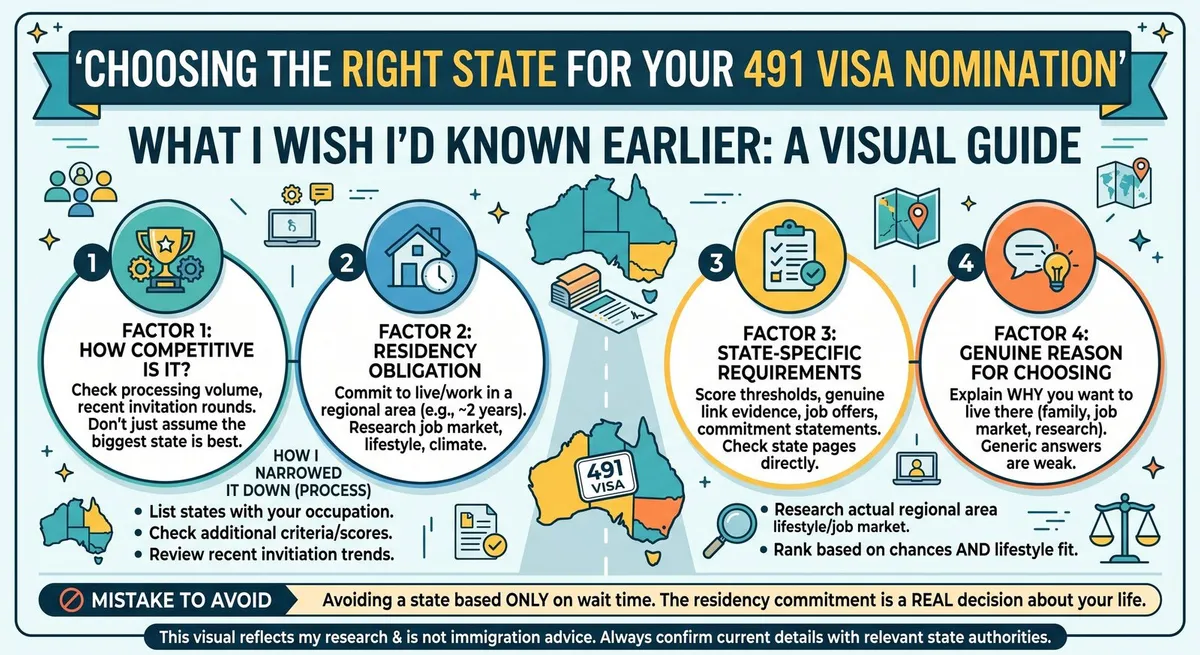
Factor 1: How Competitive That State’s Stream Actually Is
Some states receive far more applications for popular occupations than others, which affects both your odds of being invited and how quickly it happens. A less well-known regional state or territory can sometimes have a much shorter wait for the same occupation simply because fewer people are applying there. Check each state’s recent invitation rounds and published allocation information rather than assuming the biggest or most famous state is automatically the best option.
Factor 2: The Residency Obligation Attached to Nomination
This is the one that surprised me most. State nomination for the 491 typically comes with a commitment to live and work in that state, and specifically in a designated regional area within it, for a minimum period before you can apply for permanent residence. Then the visa itself requires you to live, work and study in a designated regional area (visa condition 8579, which I explain in the points test reform post). That means this is not just a paperwork decision. It is a decision about where you will be living your life for years.
Before nominating a state, research what life in that regional area looks like: the job market in your field locally, cost of living, schooling if you have children, climate and community. Not just the visa pathway on paper. With a child to think about, this mattered a lot to us.
Factor 3: Additional State-Specific Requirements
Beyond the occupation list, states often add their own conditions:
- a minimum score threshold above the federal minimum
- evidence of a genuine link to the state, such as family already living there, a job offer or prior study
- a specific commitment statement you write as part of the application
- sometimes a nomination application fee (some states charge none, others charge a few hundred dollars)
These requirements change relatively often. Treat anything I write here as a starting point for your own research, and always check the state’s current nomination page directly.
Factor 4: Your Own Genuine Reason for Choosing It
Some states explicitly ask you to explain why you want to live there, and a generic answer built purely around visa strategy reads exactly like what it is. Having a specific reason (family connections, a realistic job market in your field, research into the region that goes beyond a five-minute search) makes both your application stronger and your actual life there better once you arrive.
A Simple Comparison Table
Before you decide, put your shortlist in a table like this and fill it in from each state’s official page:
| Question | State A | State B | State C |
|---|---|---|---|
| Is my occupation on the current list for the 491? | |||
| Minimum points required | |||
| Additional requirements (link, job offer, work history) | |||
| Recent invitation activity for my occupation | |||
| Application fee and processing time | |||
| What life is like in the regional area (jobs, housing, schools) |
Seeing everything in one place makes the trade-offs much clearer than reading five separate web pages.
The Process I Would Follow
If you are starting from scratch, here is the order I would work through:
- List every state where your occupation appears on the current occupation list.
- Check each state’s specific additional criteria: minimum points, extra documentation, commitment requirements.
- Look at recent invitation trends for your occupation in each state, where that information is published.
- Research the actual regional area tied to each option: job market, cost of living, general lifestyle fit.
- Rank them using a combination of realistic invitation chances and whether you can genuinely see yourself living there for the required period.
How Timing Changed Our Thinking
We were in a hurry. Because rounds for my husband’s occupation were running, we did not have the luxury of a slow, months-long comparison. Selecting more than one state on the EOI helped: we chose Queensland, Western Australia and Victoria, Queensland responded four days later, and we lodged the nomination application on 30 March. About ten days after that, around 10 April, the nomination came through. (I do not remember whether the invitation to apply for the visa arrived the same day.) Your experience will differ, but the lesson holds: do the research early, so that when a window opens you are choosing between options you already understand. Gathering documents in parallel also saves time, since some of them (the Japanese police certificate took me about ten weeks) cannot be sped up.
A Mistake Worth Avoiding
It is tempting to nominate the state with the shortest apparent wait without looking closely at the residency commitment, and then to realise later that the regional area is not somewhere you are prepared to live long term. Unwinding that kind of mismatch after nomination is far harder than doing the research up front, so treat this decision with the weight it deserves.
The Bottom Line
Choosing a state for your 491 nomination is not just about which occupation list you appear on. It is a combination of realistic odds, the specific conditions attached to that state, and, most importantly, whether you are genuinely prepared to live in that regional area for the required period. Do the research on all of it before you commit, because state nomination is a real decision, not just a visa formality.
This reflects my own research and decision process and is not immigration advice. Occupation lists, criteria and residency requirements vary by state and change over time, so always confirm current details directly with the relevant state nomination authority.