Canadian Citizenship and a 491 Visa at the Same Time
For about six months, I was going through two different countries’ immigration systems at once: becoming a Canadian citizen while applying for an Australian skilled visa. I passed my citizenship test on 25 March, took the oath on 5 May, and lodged our 491 visa application six days later, on 11 May. This is how those two processes actually overlapped, and why finishing my citizenship first turned out to matter more than I expected.
I am not a migration or citizenship consultant. Rules for citizenship and skilled visas both change, so check the current requirements yourself if you are in a similar situation. If you want to see how the citizenship dates sit inside the whole 491 sequence, they are in our month-by-month timeline.
Why I Applied for Citizenship at All
I had already lived in Canada for 13 years, as a permanent resident, when I applied for citizenship on 13 November 2025. That was before we had properly started preparing for the 491, and it was a decision made once we had decided to leave.
The reasoning was simple: we own a home here, and we did not know for certain how things in Australia would turn out. If we ever needed to come back, or wanted to, citizenship meant we could leave and return freely, with no visa conditions attached. A permanent resident can lose that status by spending too much time outside Canada, which is exactly the risk once you move overseas.
There was a more practical reason too. I hold a Japanese passport, and renewing Japanese documents from overseas is not simple. Everything has to go through a city or ward office in Japan. My younger sibling still lives there and has had to physically go and request documents for me, then ship them overseas so I could use them here. It works, but it is slow and it depends on someone else’s time. I did not want that dependency hanging over us once we moved again, to a third country.
My husband was not part of this, and by choice. He is still covered under a national health insurance plan in his home country, kept through a family member there, and he wanted to hold onto that. His reasoning is that if he were ever seriously ill, he would rather be able to go back and be treated quickly through that system than wait through longer queues here. Becoming a Canadian citizen would have meant giving up that coverage, so he chose to remain a permanent resident instead. Our son was born in Canada, so he is already a Canadian citizen and did not need to apply for anything.
The Test: One Day of Studying
The Canadian citizenship test is multiple choice. I studied for about a single day, mostly by watching YouTube videos that cover the material, and then sat it.
I want to be honest about the timing: this fell right in the middle of preparing for PTE, which took real daily study for weeks. Citizenship studying did not get more than one day, because there was nothing left to give it. I found the test itself not especially hard. It rewards straightforward memorisation, and a lot of it is genuinely learnable in a short, focused sitting.
The test was computer-based, and I took it from home, which I appreciated. I did not have to travel anywhere, and being in a familiar space made it easier. The result came immediately, based on the number of correct answers, so there was no waiting for a letter or an email.
The Ceremony: 5 May
The citizenship oath ceremony was a different kind of event entirely: an in-person occasion, in a building set up for it, with what felt like well over a hundred other people there. A judge called people up one at a time to receive their citizenship. The whole thing took about an hour.
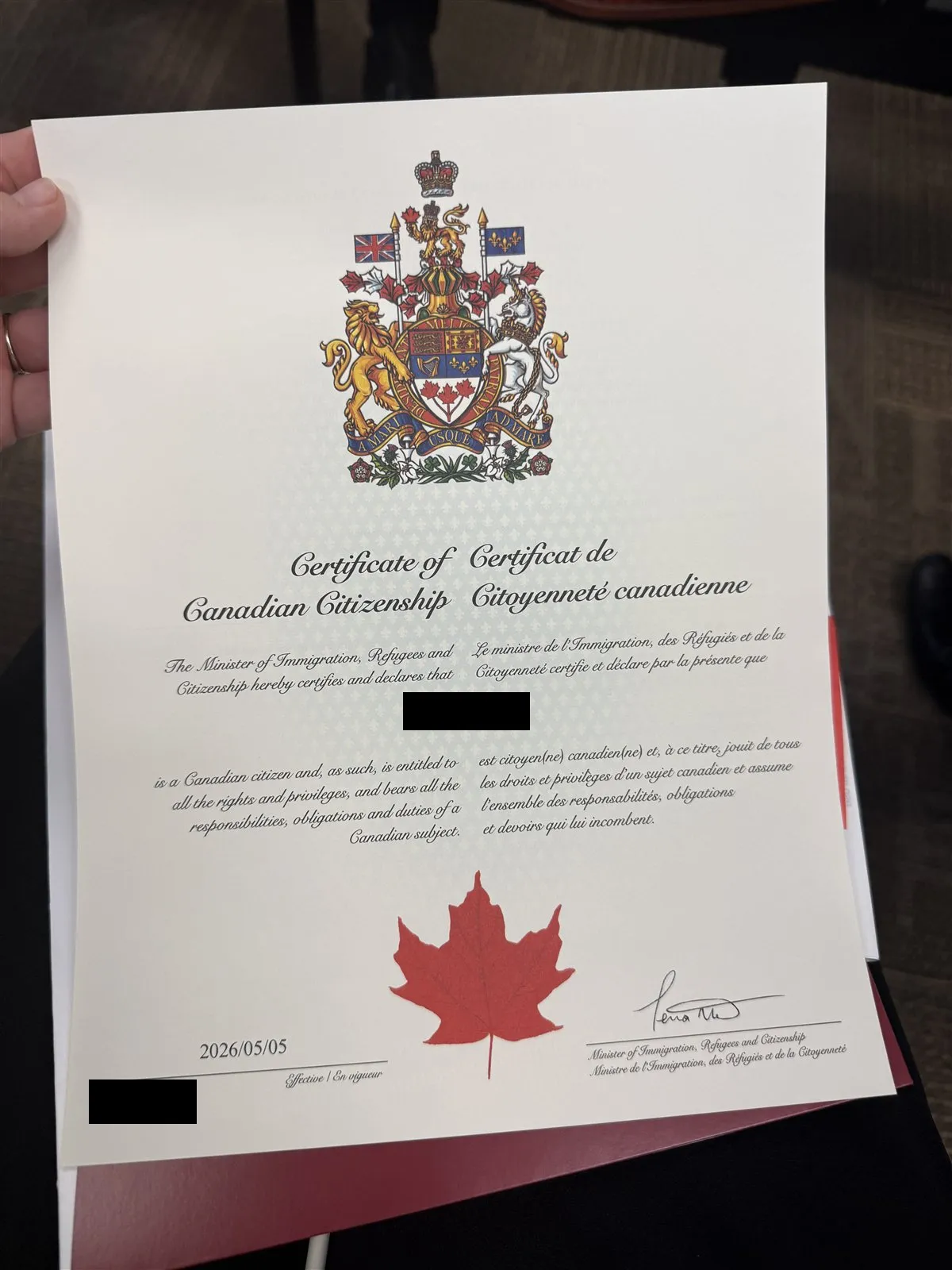
My certificate from the ceremony, with my name and certificate number covered.
My husband took the morning off work to come with me. Family were allowed to attend, and having him there mattered to me.
Honestly, my own feeling on the day was calmer than I expected. It did not feel dramatic. Mostly I just felt happy that the test was behind me and that this part was actually finished.
How It Overlapped With the 491
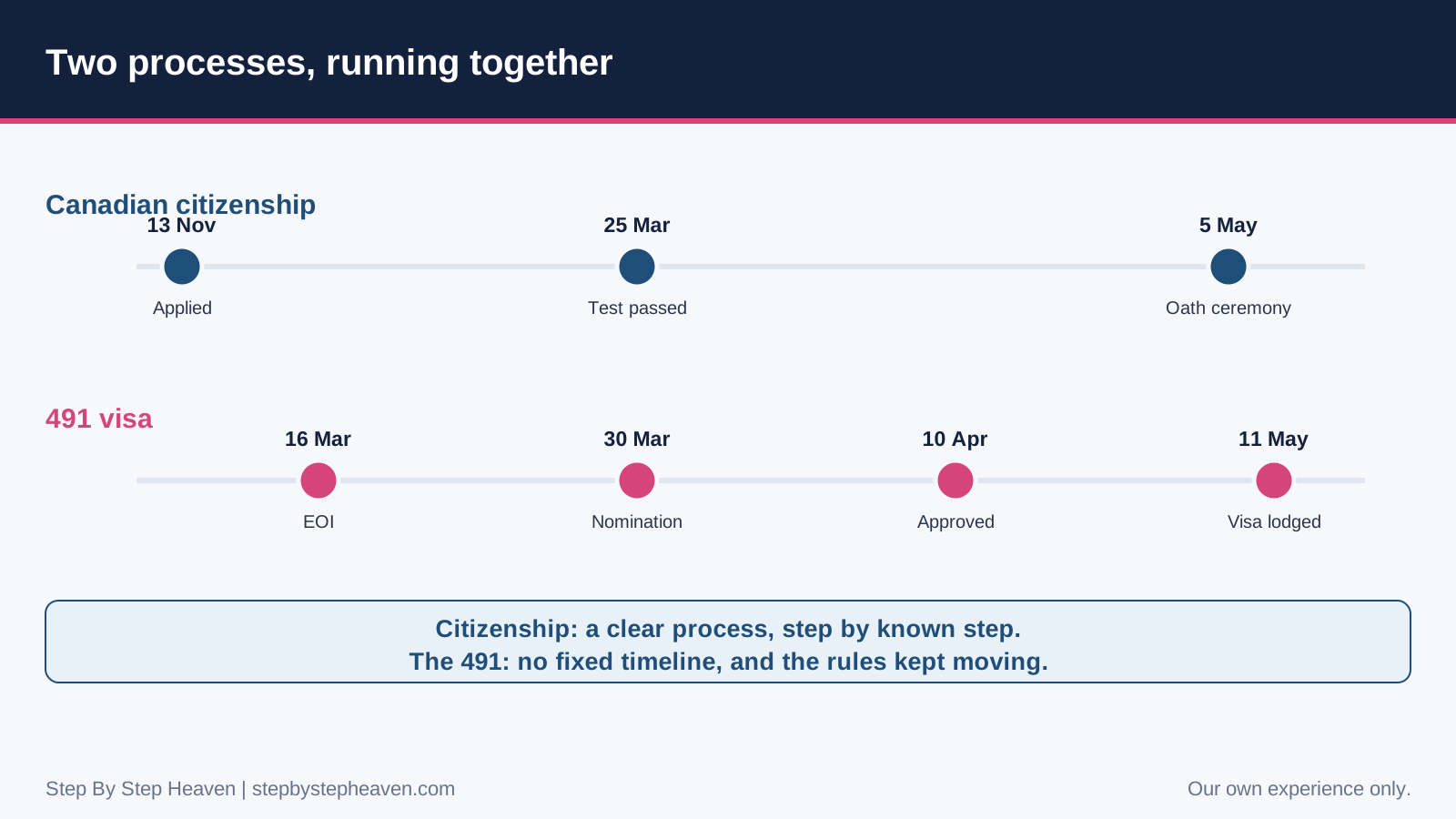
Here is the timeline as it actually unfolded, side by side:
| Date | Citizenship | 491 visa |
|---|---|---|
| 13 November 2025 | Applied for citizenship | — |
| 16 March | — | EOI submitted |
| 20 March | — | Queensland pre-approval |
| 25 March | Citizenship test, passed | — |
| 30 March | — | Nomination application submitted |
| Around 10 April | — | Nomination approved |
| 5 May | Oath ceremony, citizenship granted | — |
| 11 May | — | Visa application lodged |
Looking at that table now, it is a lot to have running at once. At the time, though, I did not feel like things collided or got confused. We had planned the sequence out in advance, so nothing surprised us or forced a scramble. It was simply a heavy, demanding stretch of months, doing a great deal all at the same time.
Practically, the two processes barely touched each other. Once I had citizenship, I updated my passport, and that was essentially the extent of the overlap in paperwork. The citizenship documents did not feed into or slow down anything on the 491 side.
The Real Difference: How Each One Felt
What struck me most, looking back, was not the scheduling. It was how differently the two processes felt emotionally.
Citizenship followed a process I could see the shape of. I submitted my application, waited, sat a test, waited again, then received the result. Every stage had a defined next step, even if I did not know the exact date it would happen. There was very little anxiety in it.
The 491 was nothing like that. I did not know when an answer would arrive, and while we were waiting, Australia kept adjusting the rules that decide which applications get looked at first. That uncertainty was, and still is, the harder thing to carry. I have written more about that in our four-month waiting update.
Would I Do It the Same Way Again?
Yes, without hesitation. We are now expecting to actually leave for Australia sometime next year, and having Canadian citizenship finished before that move has already made things simpler. If I need a document now, I deal with an office here, not one on the other side of the world that then has to ship it to me through my sibling. With a Japanese passport, everything required a request to a city or ward office in Japan, followed by an international shipment before I could use anything. It was tiring, and I am glad I am not managing that from Australia as well.
My Advice
If you are a permanent resident somewhere, eligible for citizenship, and you are also about to go through a lengthy visa process elsewhere, my advice is to switch to citizenship first if you can. It removes one source of dependency on a slow overseas system, and it gives you a home country you can return to without conditions, exactly when your life is otherwise at its most unsettled.
Where to Go Next
If you want the fuller picture of how this fit into our overall 491 journey, our month-by-month timeline lays out both processes together, and our waiting update covers what has happened since we lodged.
This reflects our own experience and is not citizenship or immigration advice. Requirements for citizenship and skilled visas both change, so confirm current details with the relevant government departments before you act.