How I Got a Japanese Police Certificate from Canada (10 Weeks)
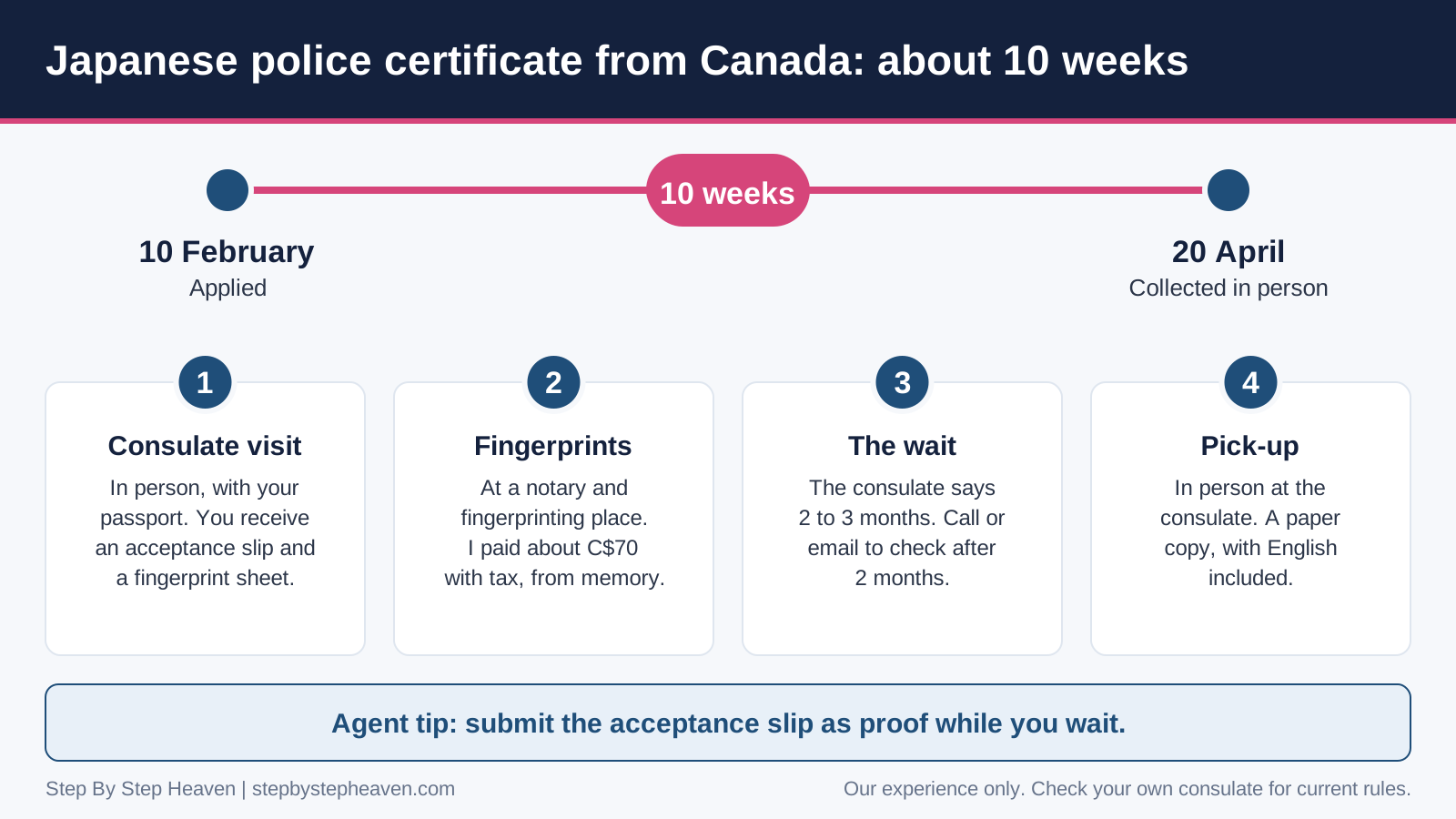
If you are applying for an Australian visa and you have ever lived in Japan, you will probably need a Japanese police certificate. In my case it was the slowest document of the whole 491 application: I applied on 10 February and collected it on 20 April, about ten weeks later. The certificate itself was issued in Japan on 18 March, about five weeks after I applied from Canada, and it then still had to reach the consulate before I could collect it. The issuing was entirely out of my hands.
I live in Canada, so I applied through a Japanese consulate here instead of from inside Japan. This post is what the process looked like from the inside, with the steps, the money, the waiting, and the trick our migration agent suggested so that the wait did not hold up the visa.
I am not a migration agent or a lawyer, and rules and consulate practices change. Please treat this as one person’s experience and confirm the details with your own consulate and the Department of Home Affairs.
Do You Need One?
Australia asks for police certificates from countries where you have lived for a set period as an adult. I am originally from Japan, so I needed one from Japan as well as from Canada. If you are not sure which countries apply to you, check the official police certificate requirements on the Home Affairs website, or ask your migration agent. I wrote about the rest of the paperwork in my real document checklist.
What the Consulate Says (Checked 25 September 2026)
The Embassy of Japan in Canada publishes a page on police certificates, and it lists the consulates by region. As of the date I checked it, the main points were:
- Japanese nationals, and non-Japanese nationals who have lived in Japan, can apply.
- You need a valid passport and proof of what the certificate is for. For Canadian immigration that is the request letter from the immigration authority; for another use, a legal basis and a request letter from the institution.
- The certificate normally comes from Japan’s National Police Agency to the consulate within two to three months.
- It is written in five languages, including English.
- The page says there is no fee.
- The office asks you to contact it first to confirm that they can take your application and to set up an appointment.
Every consulate covers a different part of Canada, so use the page above to find the one for the area where you live.
How It Went for Me, Step by Step
1. I went to the consulate in person. I brought my passport and handed in the application form. As far as I know, this has to be done in person, so it is worth checking with your consulate before you go.
2. I received an acceptance slip and a fingerprint sheet. When I submitted the application, the consulate gave me an acceptance slip. It worked like a receipt for my application. It showed my application date (10 February) and said the processing time is two to three months. That slip turned out to matter, as you will see below. They also gave me a special fingerprint sheet, a form used only for the police certificate. You cannot just print one at home.
3. I took the sheet to a place that does notary work and fingerprinting. They took my fingerprints on that sheet, and I paid them there.
4. I went home. As far as I remember, that place sent the fingerprint sheet on for me, so I did not have to take it back to the consulate. I would not rely on that, though. Ask both the consulate and the fingerprinting place what happens to the sheet afterwards. 5. I waited. Nothing happened for weeks. Because I was worried, I called the consulate to ask about it. They told me the certificate had not arrived from Japan yet and that I should keep waiting. My understanding from that call was that they would contact me when it arrived. Be careful with that, though: the printed slip says the consulate does not contact you unless there is a problem, and that you should call or email to check your status once two months have passed. So do not just sit and wait for a call. Follow up yourself.
6. I collected it in person. On 20 April the certificate was ready. I had to go to the consulate myself to pick it up. It was a paper document, in Japanese with an English translation on it.
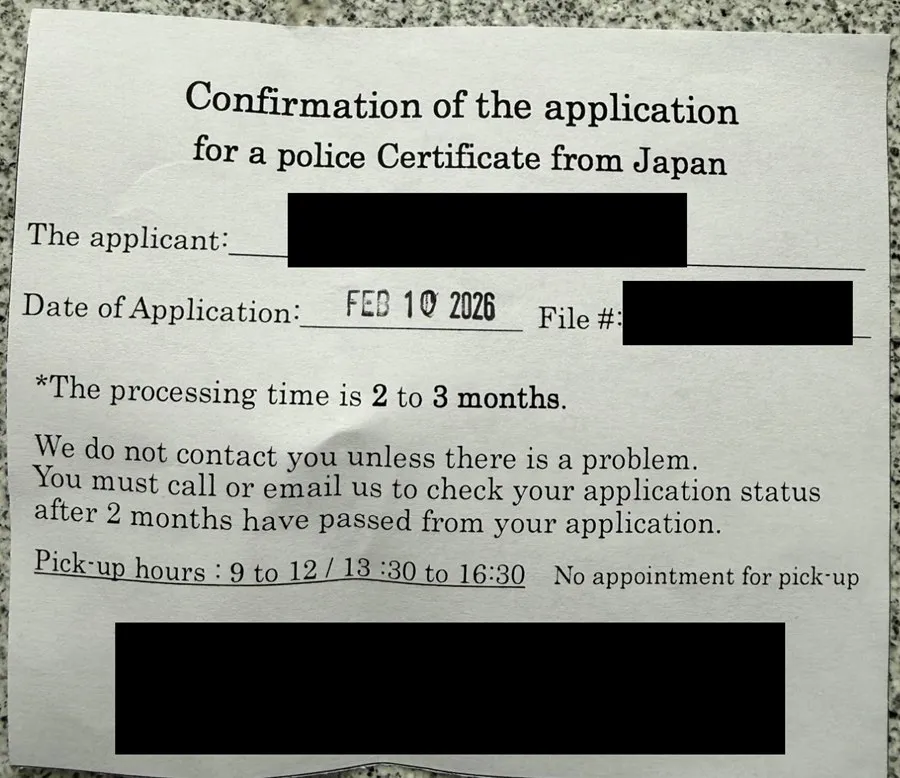
The confirmation slip I received when I applied on 10 February 2026. It says the processing time is 2 to 3 months, and that you must call or email after 2 months to check your status. I have covered my name, the file number and the consulate’s address.
What It Cost Me
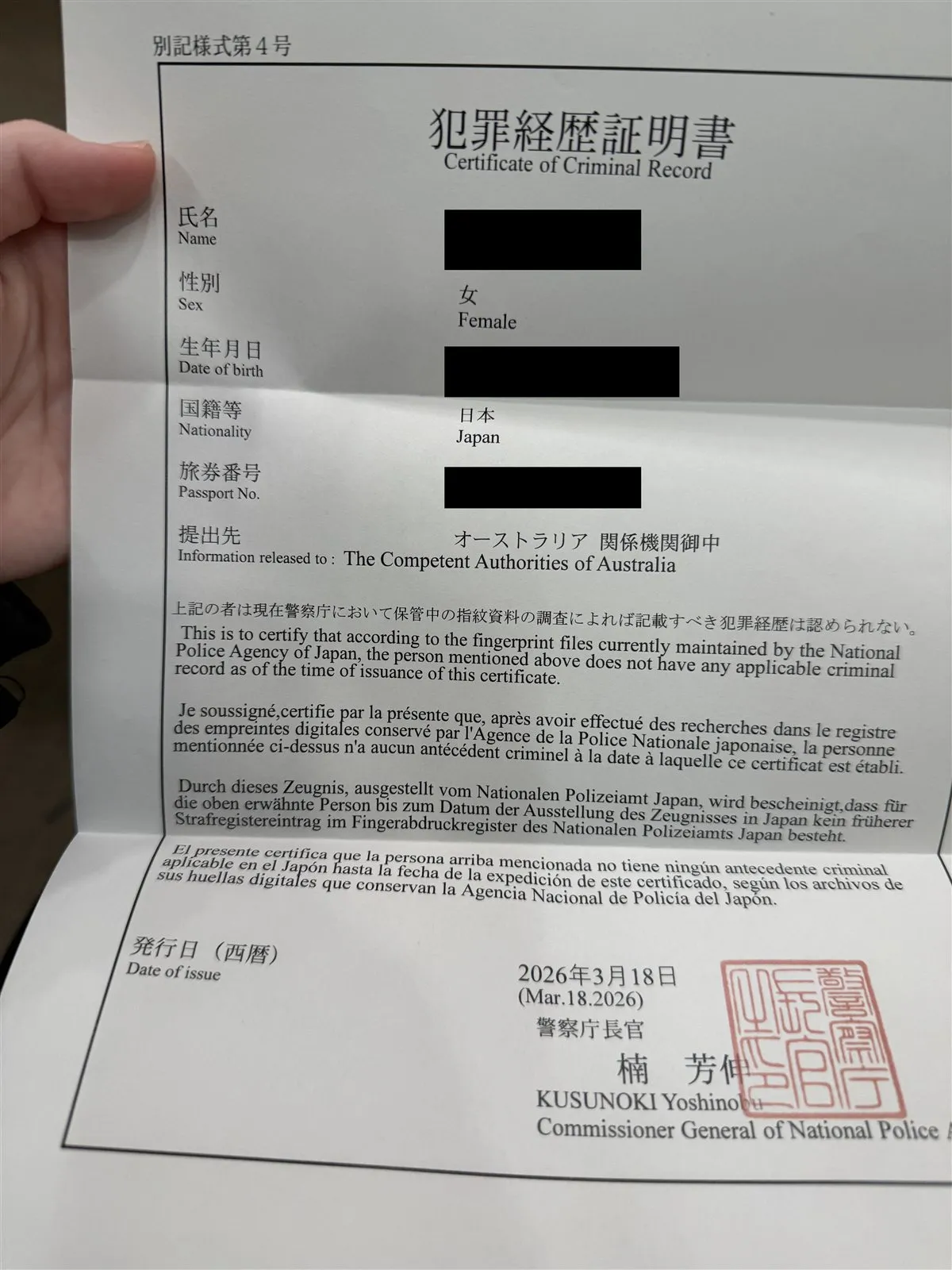
My certificate, with my name, date of birth and passport number covered. The date of issue printed on it is 18 March 2026, about five weeks after I applied from Canada. It then had to reach the consulate, and I collected it there on 20 April.
I do not remember the exact number, so please treat this as approximate. As far as I can recall, I paid in the low 60s of Canadian dollars, about 70 dollars with tax, at the place where my fingerprints were taken. That was the fingerprint and notary step, not a fee to the consulate, and the consulate page says it charges nothing itself. Prices for fingerprinting vary from provider to provider and city to city, so ask before you go.
Did I Need a Translation or Notarisation for the Visa?
No. My certificate came with English on it, so I did not need a translation, and I did not need to get anything notarised for the visa application. If you are unsure, ask your migration agent before you spend money on a translation.
The Trick That Saved Us Time: Submit the Acceptance Slip First
This is the part I most want other applicants to know. A ten-week wait can hold up everything else when you are trying to keep an application moving.
Our migration agent told us not to wait for the certificate. When we got to the point of providing our documents, the agent suggested that we submit the acceptance slip from the consulate first, as proof that I had applied. The reasoning was that Australian immigration knows Japanese police certificates take about three months, so evidence of a pending application is better than a gap. Once I picked up the real certificate, I uploaded it again to replace the slip.
This kept us from being tied to a single slow document. I cannot promise that an acceptance slip will be enough in every situation, and I am not saying this is what everyone should do. It is what our agent advised, and it worked for us. If your certificate is running late, ask your own agent or the Department of Home Affairs how to handle it.
What I Would Do Differently
Apply sooner. That is the whole lesson. If I had started as soon as I decided to go for the 491, I would have had the certificate long before I needed it, and the timeline would have been much less stressful. You can see how the ten weeks fit into everything else in my month-by-month timeline.
A few small things I would also do:
- Call or email the consulate before you go, to check that they can take your application and to book an appointment.
- Find out where you can have your fingerprints taken, what it will cost, and who sends the sheet on afterwards.
- Keep the acceptance slip in a safe place. It proved that we had applied, and it was what we submitted while we waited.
- Watch out for the validity of police certificates. Some are time-limited, so it helps to know how long yours counts for.
The Japanese Certificate, Step by Step
- Confirm which countries you need police certificates for.
- Find the right Japanese consulate for where you live and contact them.
- Bring your passport and proof of what the certificate is for, and submit the application.
- Keep the acceptance slip and note the application date, and pick up the fingerprint sheet.
- Have your fingerprints taken on the sheet and pay for it.
- Ask your agent whether to submit the acceptance slip as proof while you wait.
- Call or email the consulate to check your status once two months have passed. Do not wait for them to contact you.
- Collect the certificate in person and upload it to your application.
Where to Go Next
The Japanese certificate was the slowest item for us, but not the only one. Read our Queensland nomination story for what came next, and the mistakes we nearly made for what I nearly got wrong.
I am a Japanese-born applicant living in Canada, applying with my husband for the Australian subclass 491 visa. I am not a registered migration agent, and this is my own experience, not legal advice.