Our TRA Skills Assessment for a Construction Trade: 8 Days
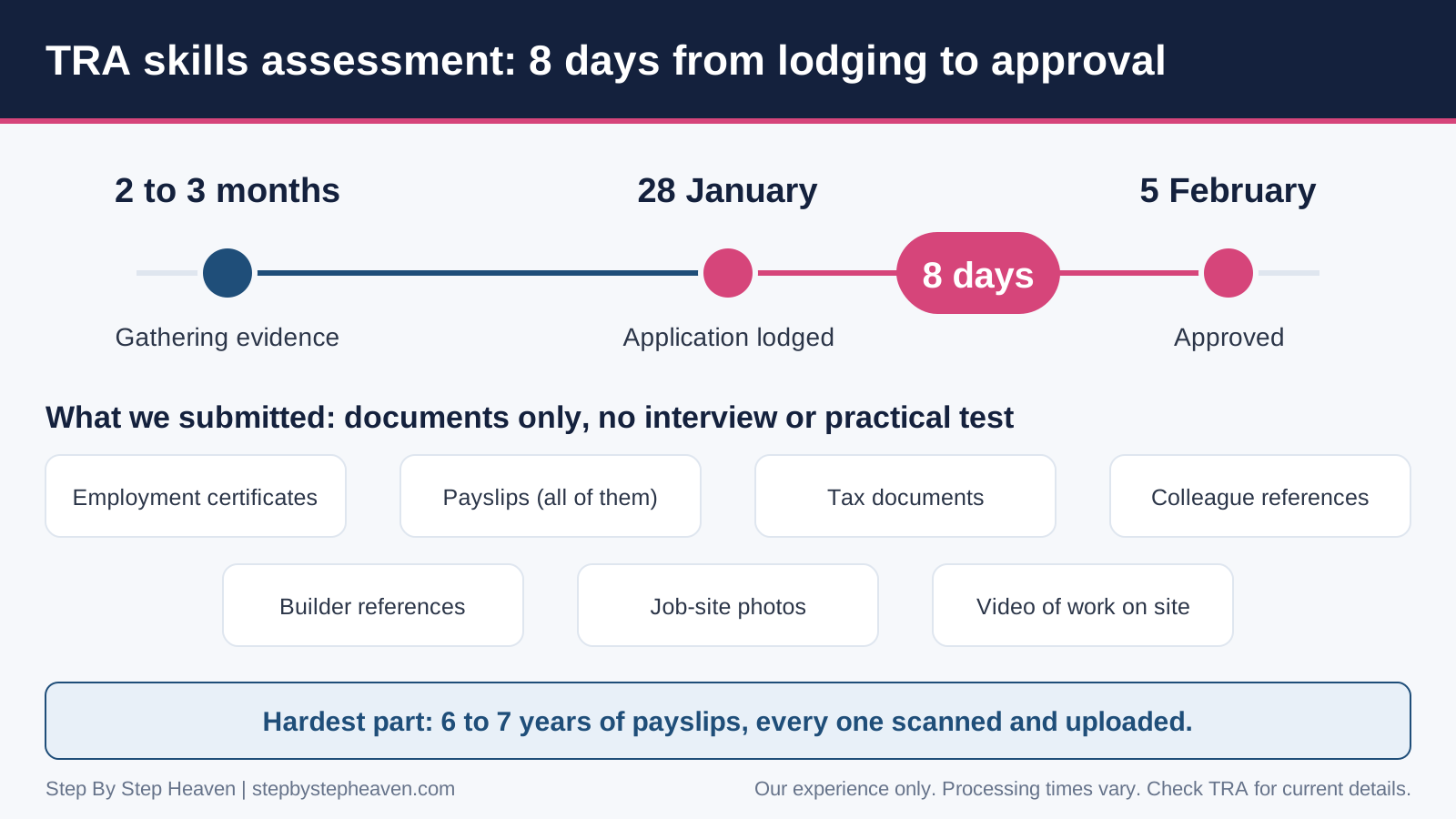
For the 491 visa, my husband needed a positive skills assessment before we could go any further. For a construction trade, that means Trades Recognition Australia, usually called TRA. We lodged his application on 28 January and it was approved on 5 February, only eight days later. That was much faster than we were told to expect, and I do not want to give you the wrong idea: the fast answer came after a lot of slow work.
The slow work was the evidence. Preparing it took us about two to three months, and the hardest part was collecting six to seven years of proof from Canadian employers. This post covers what the assessment is, what we submitted, how it worked with a migration agent, what it costs, and what I would tell someone who is starting now.
I am not a migration agent or a lawyer, and rules and fees change. Treat this as one family’s experience and check the TRA website for your own trade.
What TRA Does and Why We Needed It
TRA is the Australian government body that assesses trade skills for migration. It looks at whether a person really has the knowledge of their trade and how much work experience they have. For a skilled visa like the 491, the assessment is not optional in a trade occupation: without a positive result, we could not apply. That is why I call TRA approval a must-have, not a nice-to-have.
My husband is the primary applicant. He works in construction, and the occupation we nominated was fibrous plasterer. His work in Canada was drywall and plaster. We applied from outside Australia, and we did it through our migration agent.
TRA’s own description of the Migration Skills Assessment Program is that it is a documentary-based assessment, meaning it compares your qualifications and employment history with Australian standards for your nominated occupation. That matches what we did: everything was assessed on paper, with no interview and no practical test.
The Step Before TRA: RPL
Before TRA, we went through a process called Recognition of Prior Learning, or RPL. RPL lets a person use their real work experience to earn an Australian qualification. My husband used his years of work in Canada to earn a Certificate III. We then submitted that qualification together with his employment evidence to TRA.
Because we had proven his experience through RPL first, and had the qualification in hand, TRA assessed us on documents alone. I will not go into the RPL details in this post, because each provider has its own process, and I do not want to guess at anything that is not from our own experience.
What We Submitted
Our evidence was a mix of paperwork and proof of the actual work. As far as I remember, it included:
- Employment certificates from the companies he worked for
- Payslips, for the whole period
- Tax documents
- References from colleagues who had worked alongside him
- References from builders he had worked for
- Photos of job sites he had worked on
- Video of him working on site
Here is a small selection of the job-site photos from my husband’s phone, with the month each one was taken, read from the date on the file. They run from January 2018 to November 2025.
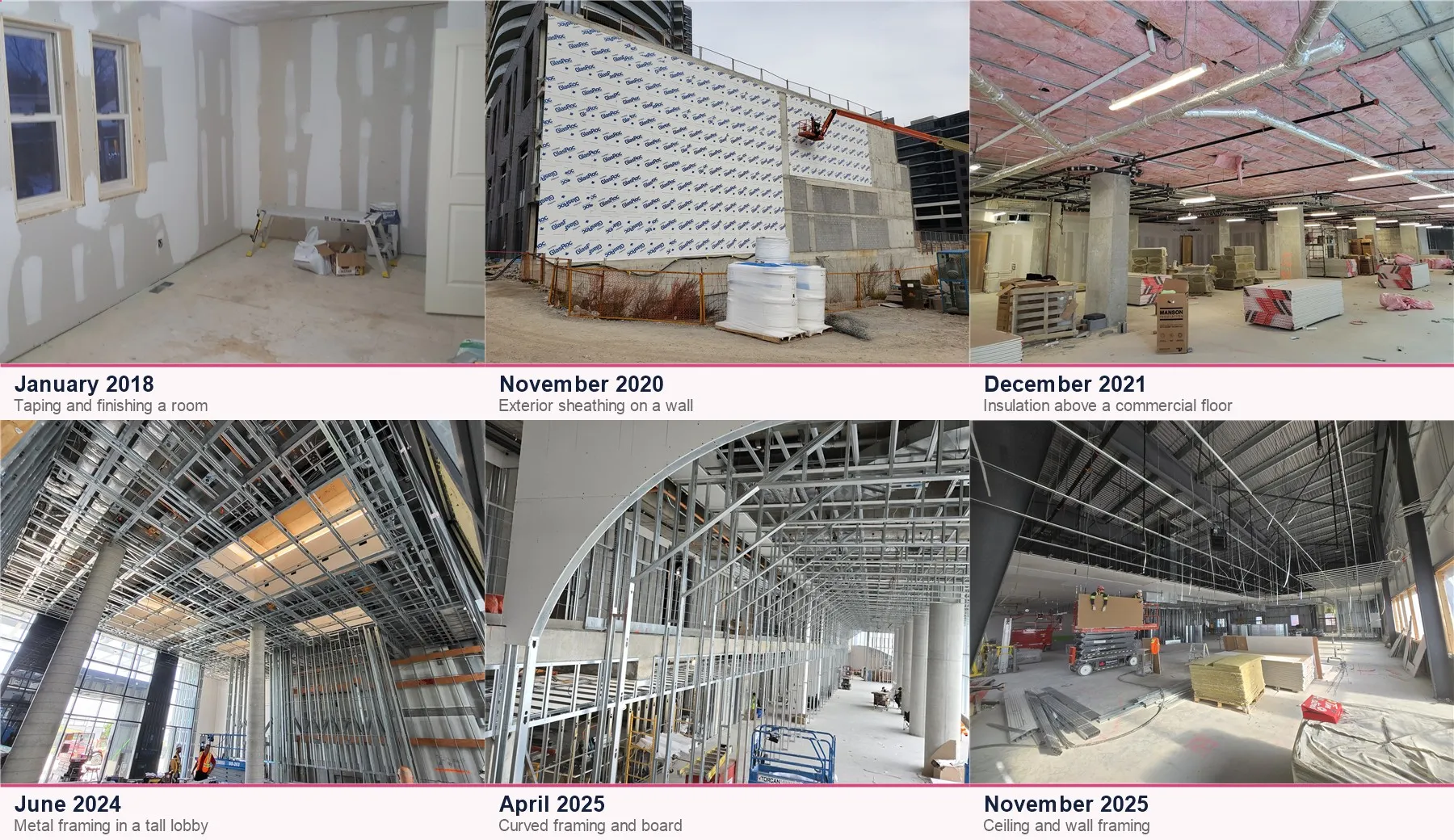
A few of the job-site photos, labelled with the month they were taken. I have left out the names and addresses of the sites.
One more, from his work photos: a sheet of board being measured before it is cut.
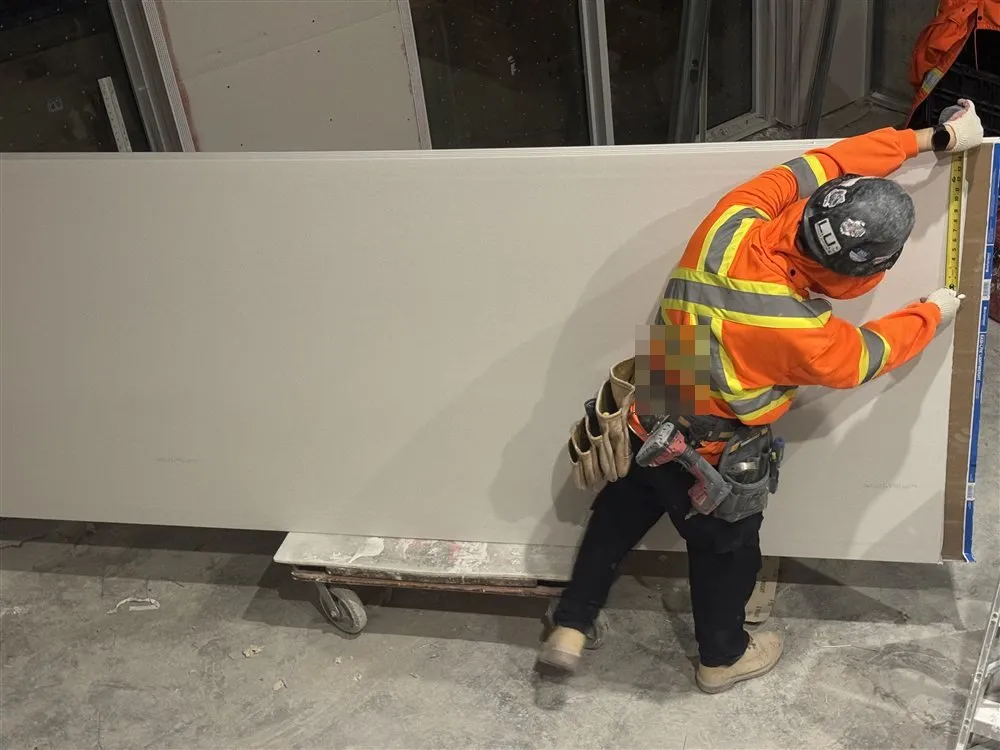
Measuring a sheet of board on site, from my husband’s work photos.
Nothing was in another language, because he worked in Canada in English, so we needed no translations.
The Hardest Part: Six to Seven Years of Proof
I will be honest: gathering the documents was much harder than I expected. We had to show six to seven years of work, and that meant every payslip, scanned and uploaded. It was exhausting.
The other difficulty was dealing with former employers. In our experience, Canadian companies were slow to respond, so getting reference letters and employment certificates meant contacting them again and again. I was sending messages and following up nearly every day, and it took several weeks before we had what we needed.
If you are starting, my advice is to begin this collection as early as you can and expect it to be the slowest part of the whole assessment. Ask former employers for letters while they still remember you, and keep every payslip you can find.
You can see where this fit into our whole journey in our month-by-month timeline, and I have also written about every other document we had to collect.
How It Worked With Our Agent
We paid our migration agent, and the agent paid the TRA fee and lodged the application online for us. Here is how the work was divided:
- The agent told us what documents were needed.
- We prepared everything ourselves, then handed it to the agent.
- The agent checked it all and lodged it.
TRA did not ask for anything else after we lodged. There was no follow-up request.
What It Cost
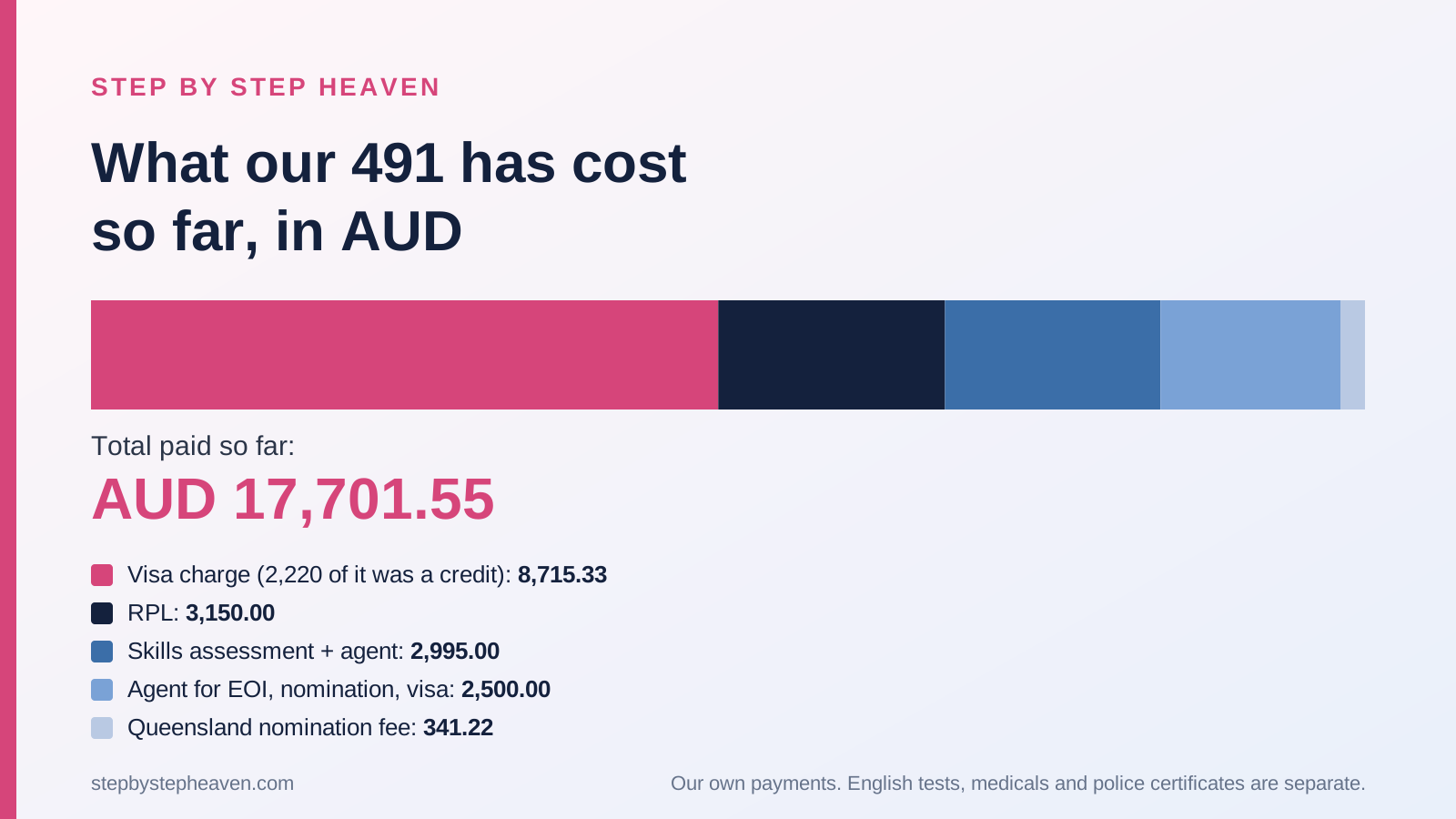
The TRA fee we paid was 795 Australian dollars, and TRA’s own Migration Skills Assessment Program page listed the same amount when I checked it on 26 September 2026. Fees can change, so please check the current figure yourself. Our agent’s fee for handling the assessment (2,200) and the RPL were separate from the TRA fee, and I list every payment in what our 491 has cost.
Timeline
| Date | What happened |
|---|---|
| About two to three months before | We gathered the evidence, including RPL and all the employment proof |
| 28 January | Application lodged |
| 5 February | TRA approved the assessment, eight days later |
Why It Was So Fast
We were told to expect about three to four weeks, and our result came back in eight days. I think our documents being very complete may have helped, but I cannot say that for certain. I also would not count on it. On the day I checked, TRA’s page said that Migration Skills Assessment applications are typically processed within 120 days, and that this is only a guide. Times differ from person to person and from month to month.
So please do not take our eight days as a promise. Take it as evidence that a complete, well-organised application can move quickly.
After the Approval
Once we had the approval, we could go on to the next steps. As I recall, we needed it for the EOI, and the approval number also had to be uploaded to the application at a later step. I do not remember exactly which step, so I will not guess. Your agent will know.
What I Would Do Differently
Not much, except starting the collection sooner. The process itself worked, and I do not think I would change our approach.
Evidence to Start Collecting Now
- Confirm with your agent or the Department of Home Affairs that your occupation needs a skills assessment.
- Check TRA’s website for the program, fee and evidence list for your occupation.
- Find out whether you need RPL first, and if so, start that early.
- Ask every former employer for reference letters and employment certificates now.
- Gather and scan every payslip and your tax documents.
- Collect references from colleagues and builders, plus photos and video of your work.
- Give everything to your agent in an organised folder.
- Keep the approval number, since you will need it later.
Where to Go Next
After the skills assessment, the next big step for us was the EOI. Read our Queensland nomination story to see what came next, and the mistakes we nearly made for the errors we tried to avoid.
I am a Japanese-born applicant living in Canada, applying with my husband for the Australian subclass 491 visa. I am not a registered migration agent, and this is my own experience, not legal advice.