IELTS vs PTE for Partner Points: Why I Switched
I sat three English tests in total: one IELTS and two PTE Academic. I needed Competent English to claim 5 partner points for our 491 application, and I did not get there on my first try. This post is what actually happened on each test day, what I scored, what it cost, and why, if I were starting again, I would skip IELTS altogether.
I am not a language testing expert or a migration agent. Test formats, fees and scoring can change, so check the current rules on the IELTS and PTE websites before you book. If you want to see how this fit into the rest of our application, I wrote about it in our month-by-month timeline.
Why I Needed the Test at All
My husband is the primary applicant on our 491. I am the partner, and claiming partner points meant proving Competent English. That is the whole reason I sat these tests. Nobody suggested a particular test to me. I chose IELTS first, on my own, and later chose PTE the same way.
Round One: IELTS (Late November, Result 5 December)
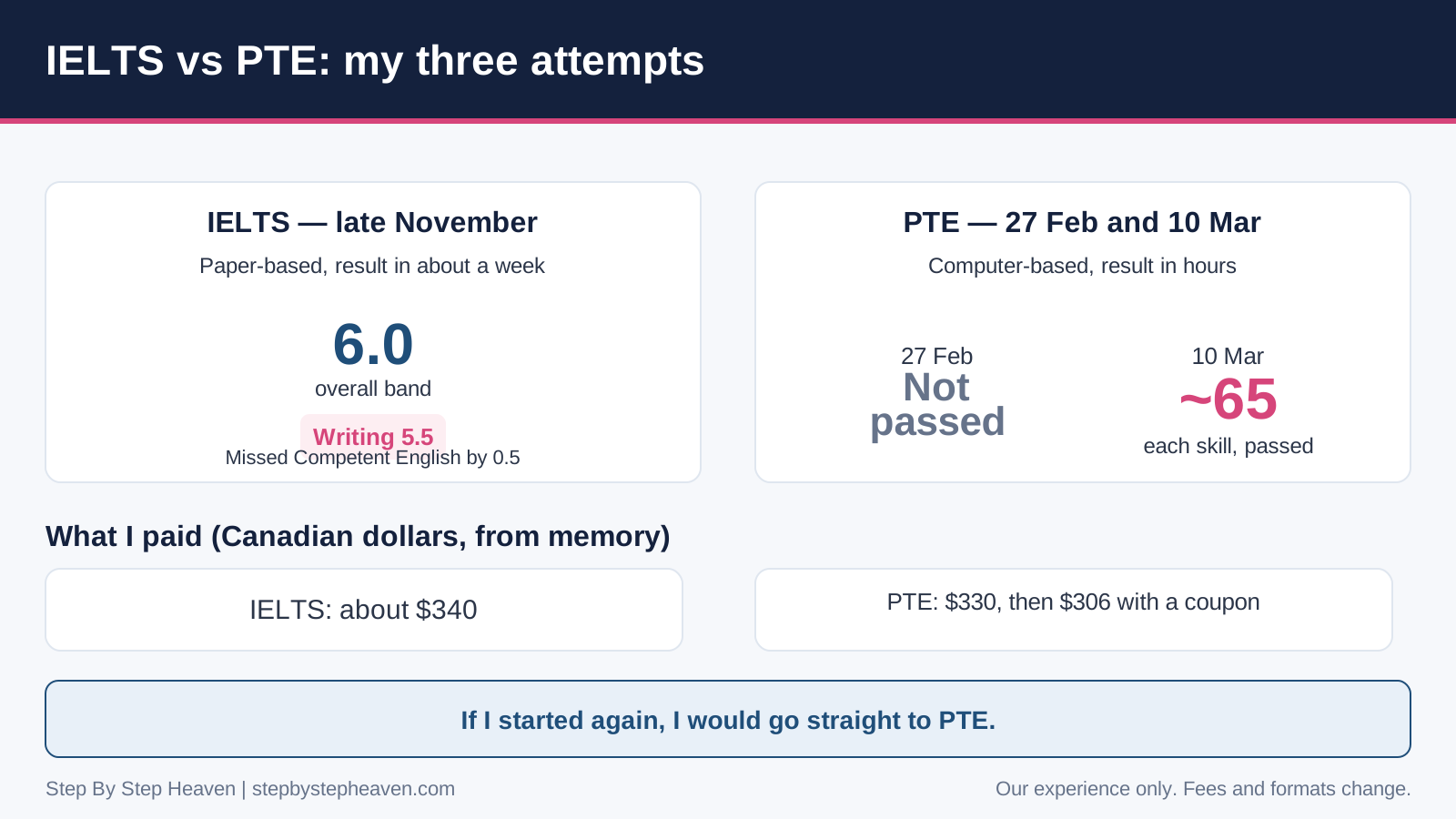
I chose IELTS first because I graduated from a school here in Canada, and I assumed IELTS would suit me better. I sat the paper-based test in late November, and the result came back about a week later, on 5 December.
My result: overall band 6.0, with writing at 5.5. Every other skill was fine. Speaking, in particular, felt easy, since it is just a conversation and I had no issue with the English itself. Writing was the one that let me down, and missing it by half a band meant I did not reach Competent English.
As far as I remember, I paid about 340 Canadian dollars. I checked the official pricing on 26 September 2026, and IELTS in Canada is currently listed at roughly 335 to 361 Canadian dollars before tax, the same for paper-based and computer-delivered. My number is from memory, so check the current price yourself.
Round Two: PTE, First Attempt (27 February)
After missing Competent English on IELTS, I decided to try PTE Academic, mostly out of curiosity about how differently it worked. It turned out to be very different.
PTE is done on a computer, in a room with other test takers, all wearing headsets. The test does not start for everyone at the same moment, so at any given time some people are speaking, some are listening, and then suddenly several people are talking at once. I found this genuinely distracting. I also went in without looking at any templates or preparation strategies, which I later learned most other test takers use. I had simply studied hard and walked in. My first attempt did not pass.
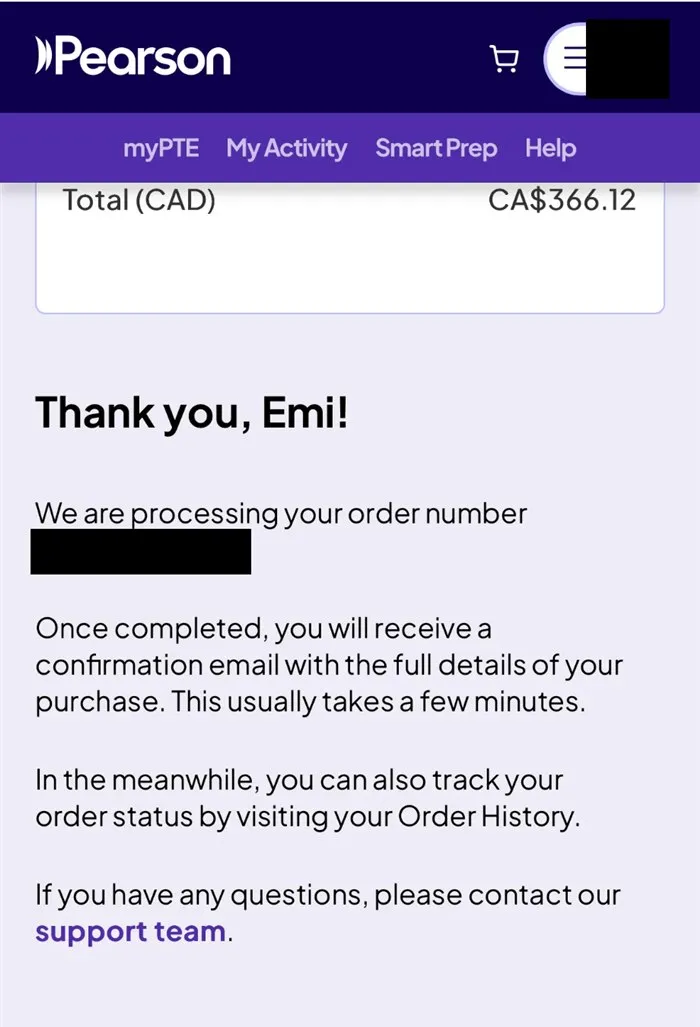
The order confirmation for one of my PTE bookings, CA$366.12 in total. I have covered the order number and my account details.
Round Three: PTE, Second Attempt (10 March, Passed)
For my second attempt I prepared properly, and I passed with roughly 65 in each skill area. The pass mark I needed was not especially high, but my score came in well above it.
My first PTE booking, made on 3 February, cost 366.12 Canadian dollars, tax included. I booked the second on 28 February, the day after my first sitting, and used a coupon, and it also came to 366.12 with tax, so my two bookings cost 732.24 together. My husband and I sat that first PTE on the same day. His booking cost about the same, but I do not have his receipt. Checking again on 26 September 2026, PTE in Canada is currently listed at around 350 Canadian dollars without a discount. As with IELTS, prices change and coupons come and go, so confirm the current fee before you book, and look for a discount code if one is available.
The result came back within a few hours, which was a shock compared to the week-long wait for IELTS.
What Made PTE’s Writing Hard
The part I found hardest in PTE was the writing. The topics themselves were difficult, there were word-count requirements to hit, and knowing that a computer would be scoring it added its own kind of pressure. It is a different kind of stress from writing by hand for a human examiner.
How I Studied: One App, No Classes
I used a single app for all of my PTE preparation: PTE Exam Practice by APEUni. I did not attend a class or use any textbook. Between my first and second attempts I studied around five hours a day. PTE breaks the test down into many more sub-skill categories than IELTS does, so there was a lot to work through. I went through thousands of practice questions in the app and treated it almost like memorising vocabulary and phrasing that tends to come up.
What helped most was simply the volume of practice questions. There are thousands in the app, and because real questions in the actual test draw from a similar pool, working through as many as possible in practice paid off directly on test day. Alongside the app, I also watched YouTube videos about PTE study strategies. I did not use any books or classes.
Fitting in study time while working and raising our son was not easy. I listened to the app on my commute, both to and from work, and during breaks at work. In the evenings, after feeding our son, playing with him for a bit and putting him to bed, I studied late into the night, often losing a lot of sleep, then went to work the next day and did it again. For those weeks, studying was more or less all I did outside of work and our son.
IELTS vs PTE: The Real Differences
Having sat both, here is what stood out to me:
- Who marks it. IELTS is marked by people. Some computer-delivered elements exist, but I think of IELTS as human-scored. PTE is mostly computer-scored, though I have heard that human review is now involved to some degree, likely because so many candidates use templates.
- Retaking a single skill. This was a real practical difference. With the IELTS paper test, if only your writing lets you down, you have to sit the entire test again. With a computer-delivered test, you can retake just the skill you failed. If I had known this beforehand, it might have changed my choice.
- Result speed. IELTS took about a week, and the result arrived by mail. PTE came back within hours.
- The atmosphere. I actually prefer the format of a paper test. But PTE’s speaking section made me more nervous than anything in IELTS, because you are sitting in a room of other candidates, and while nobody can hear your recording being scored, everyone can hear you talking out loud into your headset while you do it. That self-consciousness stayed with me the whole time.
- Speed of preparation. If you need to raise your score quickly, I think PTE has the edge. Templates are widely used, and because the question pool repeats, memorising common answers can genuinely move your score in a short time.
What I Would Do Differently
If I were starting again, I would go straight to PTE and skip IELTS entirely. IELTS ended up being time I did not need to spend. Between the cost of a test I did not pass and the extra weeks it added to our timeline, going PTE-first would have been the more direct path for me.
My Advice
Take PTE. That is my honest recommendation, especially if speaking to a live examiner makes you anxious, since IELTS speaking is a real conversation with a person. With PTE, use an app or bank of practice questions from day one, learn the templates instead of avoiding them like I first did, and expect to put in real hours. It rewards volume of practice more than natural fluency alone.
What I Would Do Before Booking an English Test
- Confirm which English level you need and how many points it is worth.
- Compare current fees for IELTS and PTE before you book.
- If you may need to retake just one skill, consider a computer-delivered test from the start.
- Use an app with a large practice question bank, and start early.
- Learn the writing templates rather than skipping them.
- Build a study routine you can sustain around work and family, since results depend on consistent hours, not last-minute cramming.
Where to Go Next
English points were one part of a much bigger points calculation. Read our SkillSelect points guide for how the rest of it fit together, and our full document checklist for everything else we had to gather.
I am a Japanese-born applicant living in Canada, applying with my husband for the Australian subclass 491 visa. I am not a registered migration agent, and this is my own experience, not legal advice.