7 Mistakes That Get 491 Visa Applications Rejected (and How We Tried to Avoid Them)
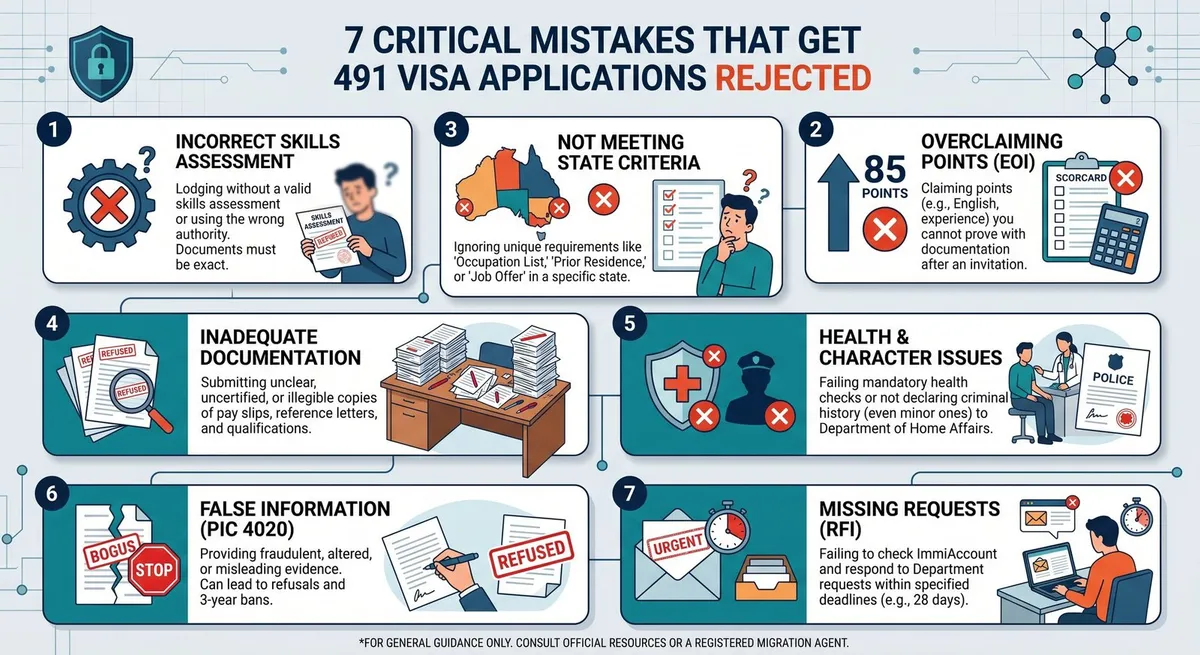
Most people assume a visa gets refused because they were not eligible. From everything I have read, and from working through the process with my husband, that is rarely the real reason. Most problems come from small, avoidable mistakes in the paperwork, not from someone genuinely failing to qualify. We were working to a tight timeline, which made us nervous about every one of these, so here are the seven I paid most attention to, and what we did about them. My husband is the primary applicant, in construction, and I am the partner.
1. Lodging With the Wrong or Invalid Skills Assessment
A skills assessment has to come from the right authority for your nominated occupation, and it has to be valid. Lodging with an assessment from the wrong body, one that has expired, or one that does not match your nominated occupation is a mistake that cannot be fixed by extra paperwork later. Confirm the assessing authority for your occupation from the official source, and track the expiry date from day one, not just the date you applied.
2. Overclaiming Points You Cannot Prove
It is tempting to round up: claim a job as full-time when it was closer to part-time, or count experience from a role where your actual duties did not quite match your nominated occupation. Every point on your EOI has to be supported with documents after an invitation. Case officers can cross-check payslips, tax records and reference letters against each other, and if the numbers do not line up, it can cast doubt on the rest of your application.
Our situation made the temptation stronger. Age had already cost us points, and we needed everything we could legitimately claim. That is exactly why we only claimed what we could document. My partner points, for example, depended on a real English result, so I earned them the honest way, over three English tests. I tell that story in my English score post.
3. Not Meeting the State’s Own Criteria
For the 491, a state or territory must nominate you, and each has its own priority occupation list and conditions: minimum points, evidence of a link to the state, commitment statements, residency expectations. It is easy to spend so much time on the federal visa requirements that you overlook the state’s own rules. Read your state’s current nomination criteria in full before applying, and do not assume they match the federal checklist. I cover the decision in how to choose a state.
4. Inadequate Documentation
This is one of the most commonly cited causes of delay and refusal. Unclear scans, uncertified copies, illegible pay slips, vague reference letters and missing translations all slow an application down or sink it. A reference letter that says “worked here as a good employee” tells a case officer nothing. What they need is your job title, specific duties matching the occupation’s task list, dates, and hours per week.
Overseas paperwork is the easiest to underestimate. A police certificate from Japan took about ten weeks for me, and documents in another language need a certified translation. Start these early and keep everything in one organised folder. I list all of it in the document checklist post.
5. Health and Character Issues
You will need health examinations and police certificates from the countries where you have lived, and you must declare any criminal history, even minor. Failing to declare something that later appears in a check is far more damaging than the original issue would have been. Book health examinations through an approved panel physician and gather police certificates well ahead of time, because some countries take months.
6. False or Misleading Information
Providing altered, fraudulent or misleading evidence (Public Interest Criterion 4020) can lead to a refusal and a period during which you cannot be granted certain visas, commonly three years. Honesty is not just the ethical choice. It is the only choice that does not put your whole application at risk. If a document does not say what you need it to say, get a correct one rather than adjusting it.
7. Missing Requests for Information
After lodgement, the Department may ask for more documents or clarification through your ImmiAccount. These requests come with a deadline, commonly 28 days, but check the deadline stated in your notice. Ignoring them, or missing the notification email, can lead to a decision on the information already provided. Check your ImmiAccount and your email regularly, and respond on time, even if you need to ask for more time.
Smaller Traps That Still Matter
A few more things that are easy to get wrong:
- Expired tests. English results and skills assessments are valid for a limited time. If you wait a long time for an invitation, one of them can lapse.
- Inconsistent personal details. Names, dates of birth and spellings must match across your passport, certificates and forms.
- The 60-day window. After an invitation, you generally have 60 days to lodge. Start collecting time-sensitive documents, such as police checks, as soon as your EOI is submitted, not after you are invited.
- Translations that are not certified. Not every translator qualifies.
What These Mistakes Have in Common
None of these are about whether someone genuinely qualifies for the visa. They are about documentation, timing and attention to detail. That is good news, because it means most of them are entirely within your control, as long as you know to look for them ahead of time rather than discovering them the hard way.
How We Would Approach It Next Time
If we were starting over, we would start the slowest items, English and overseas police certificates, before anything else. We would build a single list of every claim we are making (each job, each point, each qualification) next to the exact document that backs it up. Any gap between what you claim and what you can prove becomes visible right away, instead of surfacing after lodgement when it is much harder to fix.
The Bottom Line
A 491 refusal is rarely about not being good enough on paper. It is much more often about a detail that got missed, a document that expired, a state requirement that was overlooked or a request that was ignored. Go through this list honestly against your own application. It is a lot easier to fix now than after you have lodged.
This reflects my own experience and reading and is not immigration advice. Requirements and conditions vary by individual case and change over time, so always confirm current requirements with your assigned state nomination authority or a registered migration agent. See also the document checklist.